by Marc Moquette
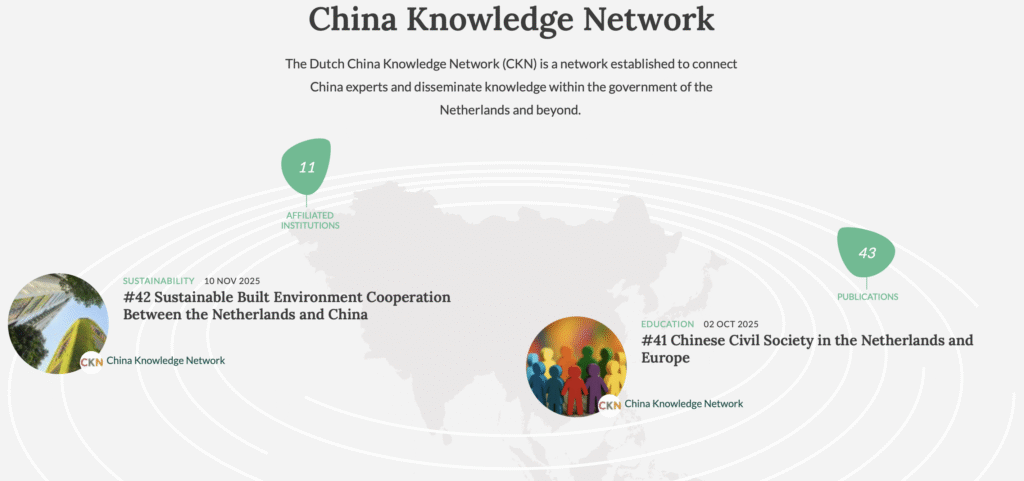
In this article, Marc Moquette explains what the China Knowledge Network is and the important role it plays in Dutch and European policymaking on China and international relations. The many links in the article lead you to the referenced notes and reports for further reading and deeper understanding.
What is the role of the China Knowledge Network?
The China Knowledge Network (CKN) is growing and developing rapidly. It supports the Dutch government by generating knowledge and fostering awareness of the multifaceted relationship between the Netherlands and China. This quarter, the network is publishing five research reports, hosting its second masterclass of this year for diplomats and civil servants and concludes discussions with all ministries on its work programme for the coming year.
This spring, CKN started a European partnership, with the German MERICS and the Swedish National China Centre. With this European China Knowledge Network ECKN, we strengthen cooperation on policy research and awareness in Brussels by organising seminars and conversations in which various bureaucratic and academic players share and develop their knowledge.
In May, the public launch of CKN Cosmolab took place with the screening of a short introductory video in the Haags Filmhuis. This lab focuses on dealing with the complexity of current international relations, in order to explore and be able to take new diplomatic paths. CKN works with civil society and international partners to uncover blind spots in knowledge and awareness on both sides of the Europe-China relationship.

Three body problem
CKN stems from the 2019 China Memorandum, ‘A New Balance’. That same year, the European Commission published its Strategic Outlook. Since then, both the government and the Commission have seen China as a partner, competitor and systemic rival. This put an end to the political assumption of ‘Wandel durch Handel’: the idea that China would gradually integrate itself into the multilateral system and open up and liberalize its own economy according to established values and norms around democratic governance and free market forces. Meanwhile, the centre of gravity of the EU-China relationship is moving further and further towards the protection of Europe’s security and competitiveness. At the same time, the isolationism and increasingly authoritarian nature of the US under Trump II are putting pressure on the multilateral system and the transatlantic relationship. China has publicly indicated that it cannot afford for Russia to lose the war in Ukraine, because the US can then focus entirely on its rivalry with China. The Netherlands and Europe are facing a ‘three body problem‘: a fleeting balance between great powers on which our national and European influence is increasingly limited. Europe is a large market, productive and has a good quality of life. But Europe is also internally divided and dependent for its energy, raw materials and technological development.
Identifying blind spots
In order to remain policy-relevant in this new world, CKN is stepping up its efforts: in addition to analysing developments within China and Chinese intentions on the world stage, CKN draws attention to current relations – a less influential Europe – and examines strategies for the Netherlands in an increasingly transactional world politics. In doing so, CKN follows recommendations of the Scientific Council for Government Policy (WRR) ‘The Netherlands in a fragmenting world order’. Dutch diplomacy will only be able to properly communicate shared interests to new partners if it is better able to speak from worldviews that are not its own. Inviting your new partners to join ‘our’ universal program doesn’t work anymore if they don’t feel part of it. Our partners see new options where they don’t need us and that’s new to us. We ourselves need to become more aware of our own blind spots. This results in a strong political dynamic that CKN explores in policy studies (e.g. into the ‘internationalisation of the Chinese currency‘ and ‘industry standards‘), but also makes it a topic of public conversation in his CKN Cosmolab.

Scientific and philosophical underpinnings
CKN provides this difficult conversation with a solid foundation with insights from contemporary science and philosophy. Philosopher Markus Gabriel warns us against our own naïve realism. Theoretical physicist Carlo Rovelli reminds us that our knowledge is not separate from the reality we describe with it and urges us to look less at objects and more at relationships, of which we ourselves are a part. Conversations with European, Indian and Chinese thinkers illustrate what is involved in getting to know and working with each other’s worldviews. We also have conversations with people from the field of research and policy. This shows that the national government has work to do to get its own knowledge and awareness up to the level of geopolitical, social and ecological challenges. For example, by taking better account of the monetary developments, our blindness to energy and materials, and technological diversity as part of a planetary strategy with new partners. Here CKN translates the line of the Consultation of Secretaries-General and the WRR to allow knowledge to play a more central role in national policy in practice. It is of course unruly and comes up against the usual characters of competence drive, risk avoidance and short-term thinking. The fact that CKN is shaping cooperation between all ministries and a network of hundreds of researchers, and is focusing more on Brussels, makes it a knowledge initiative that contributes to a future-proof foreign policy. There is still an undiminished need for China-specific knowledge and awareness, which is increasingly being integrated into the government-wide organisation and strategy. Only in this way can available expertise translate into expert action.
Marc Moquette works as Special Envoy for Knowledge for China at the CKN, Ministry of Foreign Affairs