Welcome to the China Cafe!
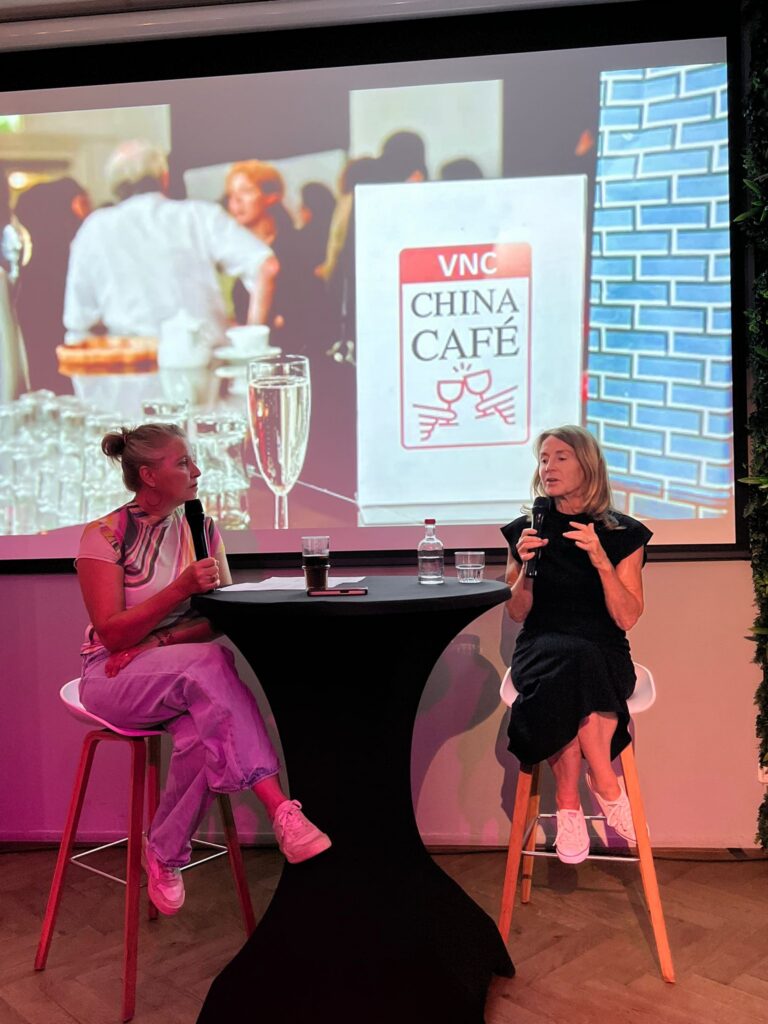
Since 2007, the place where professionals dealing with China on a daily basis meet and share knowledge. The China Cafés are low-threshold, informal gatherings with an emphasis on business and open to everyone. Each China Café focuses on a different topical theme with an interview with experts from the bar stool and plenty of opportunities to talk to each other.
The next China Café will take place on 21 September 2026. This time the theme is: Responsible Entrepreneurship in Europe and China
What does corporate responsibility mean in Europe and China? While expectations about social and environmental impacts are increasing in both markets, the underlying priorities can differ significantly. In the EU, there is a strong emphasis on individual and labour rights, while in China social responsibility is more linked to broader economic and social development goals.
During this China Café , Vera Moll, partner at KPMG, and Congrui Qiao, researcher at China Knowledge Network, will use real-life examples to show how these differences can lead to misunderstandings, as well as financial and reputational risks. More importantly, they will explore how companies can successfully navigate these cross-border frictions and turn them into strategic opportunities.
Note: New location:
Café De Apotheek, Catharijnesingel 57, Utrecht
5 minutes walk from Utrecht Central Station. Parking is available at Hoog Catharijne P1
Report from the last China Cafe
Report China Café on June 8 in Utrecht, with Heleen Mees
China’s export machine at full throttle: “We should be happy if it remains just a trade war.”
During the last China Café on June 8, 2026 at the Stadsbrasserie de Utrechter, economist and China expert Heleen Mees was a guest. She provided a clear and occasionally alarming picture of how China, following the bursting of the real estate bubble in 2021, consciously chose to scale up its industrial export model. Although it was expected that China would focus on domestic consumption, the country now produces about 35% of all global manufacturing output. During a one-hour Q&A led by VNC board member Lianne Baaij, Mees discussed what a further scaling up of this means for Europe and the Netherlands.
From real estate bubble to export machine
From cheap export goods to real estate and investment-driven growth, and then back to industry and export, but of a completely different caliber. In this way, Mees outlined the different phases that the Chinese economy has gone through over the past three decades. It used to be underpants, Christmas items and other cheap bulk items, but now it is electric cars, solar panels and advanced semiconductors in which China sets the tone. This technological upgrade was a deliberate step with the “Made in China 2025” plan launched in 2015. That switch got an extra boost with the onset of the real estate crisis around 2020. At its peak, real estate accounted for 28% of China’s GDP. After the collapse of Evergrande, whose shares turned out to be worthless in 2025 and were delisted from the Hong Kong stock exchange, and the subsequent crisis, this share is expected to fall further to around 12%. The economic activity that disappears as a result will have to be absorbed by other sectors.
Podcast of the penultimate China Café
The interviews at the China Café are always recorded and converted into a podcast by our volunteers. The language is English. Listen to the podcast of the last China Café here.
Events
-
-
September 21st, China Café about Responsible Business
Organized by VNCDe Apotheek Catharijnesingel 57, UtrechtBeyond the Mismatch: Building Responsible Business Between Europe and China What does responsible business mean in Europe and China? While expectations around social and environmental impact are growing in both […]