by: Lotte Bakker
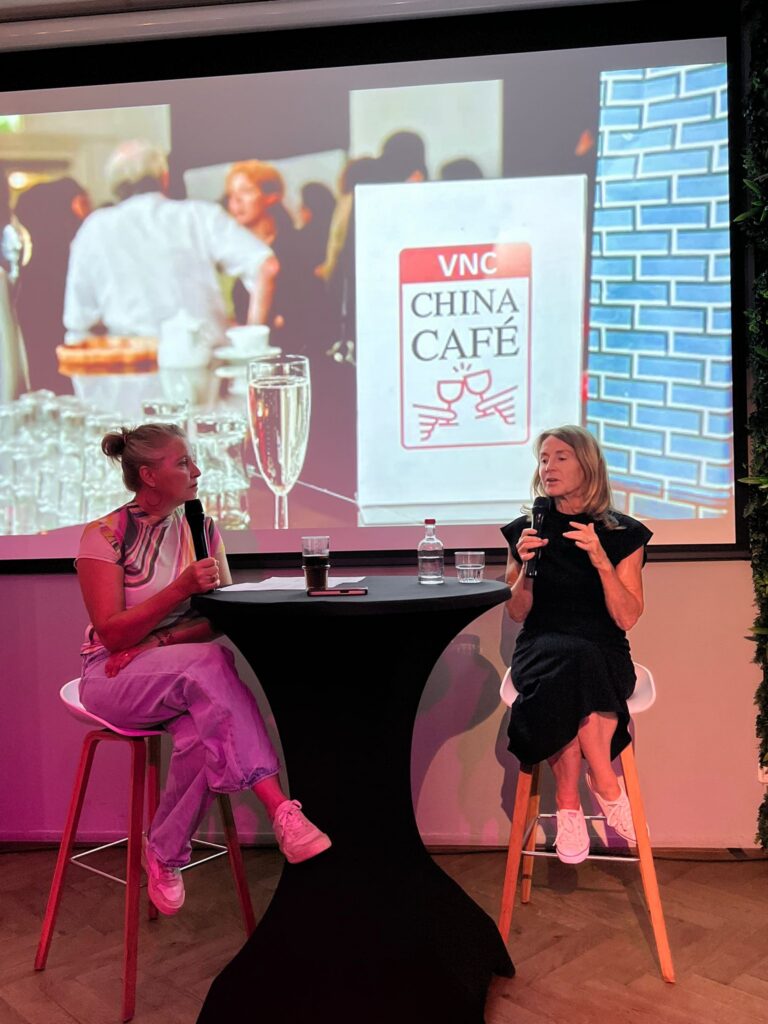
During the last China Café on June 8, 2026 at the Stadsbrasserie de Utrechter, economist and China expert Heleen Mees was a guest. She provided a clear and occasionally alarming picture of how China, following the bursting of the real estate bubble in 2021, consciously chose to scale up its industrial export model. Although it was expected that China would focus on domestic consumption, the country now produces about 35% of all global manufacturing output. During a one-hour Q&A led by VNC board member Lianne Baaij, Mees discussed what a further scaling up of this means for Europe and the Netherlands.
From real estate bubble to export machine
From cheap export goods to real estate and investment-driven growth, and then back to industry and export – but of a completely different caliber. This is how Mees outlined the various phases the Chinese economy has gone through over the past three decades. Where there used to be underwear, Christmas items, and other cheap bulk goods, China now sets the tone with electric vehicles, solar panels, and advanced semiconductors. This technological upgrade was a deliberate initiative with the “Made in China 2025” plan, launched in 2015. This transition received an extra boost with the onset of the real estate crisis around 2020. At its peak, real estate accounted for 28% of China’s GDP. Following the fall of Evergrande—whose shares proved worthless in 2025 and were delisted from the Hong Kong Stock Exchange—and the subsequent crisis, this share is expected to fall further to around 12%. The economic activity that disappears as a result will have to be absorbed by other sectors.
Why not a consumer society?
Stimulating domestic consumption should have been the answer to the real estate crisis, according to many. And yet, this has not happen. Mees cited four reasons for this. First, there is national pride: high-tech production provides a certain status and proves that China can surpass the US. Secondly, demographics play a role. China risks growing old before it is truly rich, and consumption does not drive real wealth growth. Third, China wants to become geopolitically more independent of the West, following the chip restrictions under Trump and Biden. Finally, Xi Jinping’s ideology plays an important role. His own experiences during the Cultural Revolution shaped his thinking. He sees consumer societies as weak and believes they do not make people happier. In his view, sacrifice and discipline are necessary to anchor loyalty to the Party.
Impressive and worrying figures
China now produces about 35% of all global manufacturing and is heading towards nearly 50% by 2030. Remarkably, only 11% of this production is consumed domestically. The vast majority is destined for export. In 2025, the trade surplus reached a record level of approximately 1,000 billion euros. A third of China’s economic growth that year came from the export sector, the highest share since the nineties. At the same time, domestic consumption lagged behind with growth of only 2%, while the economy as a whole grew by 5%.
A divided and vulnerable Europe
Mees was not very complimentary about the European response to this growth: China is consciously playing EU countries against one another. This happens through targeted lobbying in, for example, Spain, but also through indirect pressure, such as threats of stricter meat inspections following European tariff investigations. Even European import tariffs on Chinese electric vehicles appear less effective than intended, because hybrids fall outside the measures. Attempts to reduce strategic dependency on China are also struggling. A proposal from the European Commission to require companies to have a minimum of three suppliers was withdrawn by Spain after just one day. On top of that, decades of outsourcing have resulted in the loss of much production and process knowledge in Europe. In other words, Europe is increasingly unsure how to produce on a large scale itself. As Mees puts it: “If we want to maintain our standard of living and not be economically colonized, we must stand up for ourselves and make the effort ourselves”.
Looking ahead
The session with Heleen Mees was concluded with several questions from the audience, including the consequences for the Netherlands (which, according to her, are relatively limited due to the small size of the manufacturing industry), the service sector in China and the hukou system. In her closing remarks, Mees painted a sober yet alarming picture. According to her, China is ahead in about 90% of all advanced technologies. Although the demographic contraction will become painfully noticeable in twenty years, the country will remain a major economic and geopolitical challenge until then. “We should be happy if it remains just a trade war,” says Mees.
Heleen Mees is an economist, opinion maker and author of four books. She is a lecturer at various universities, including New York University and the Vrije Universiteit in Amsterdam. Her research focuses on the impact of China’s rise on the West. Her work has appeared in newspapers and magazines such as Foreign Policy, The New York Times, The Financial Times and Le Monde. She is also co-founder of an NGO that works to increase the number of women in top positions. She divides her time between New York and Amsterdam, but lived for a year (2015) in Doujiao Hutong in Beijing. (Heleen Mees on LinkedIn https://www.linkedin.com/in/heleenmees )
Listen to the podcast on: