by Jaap Post
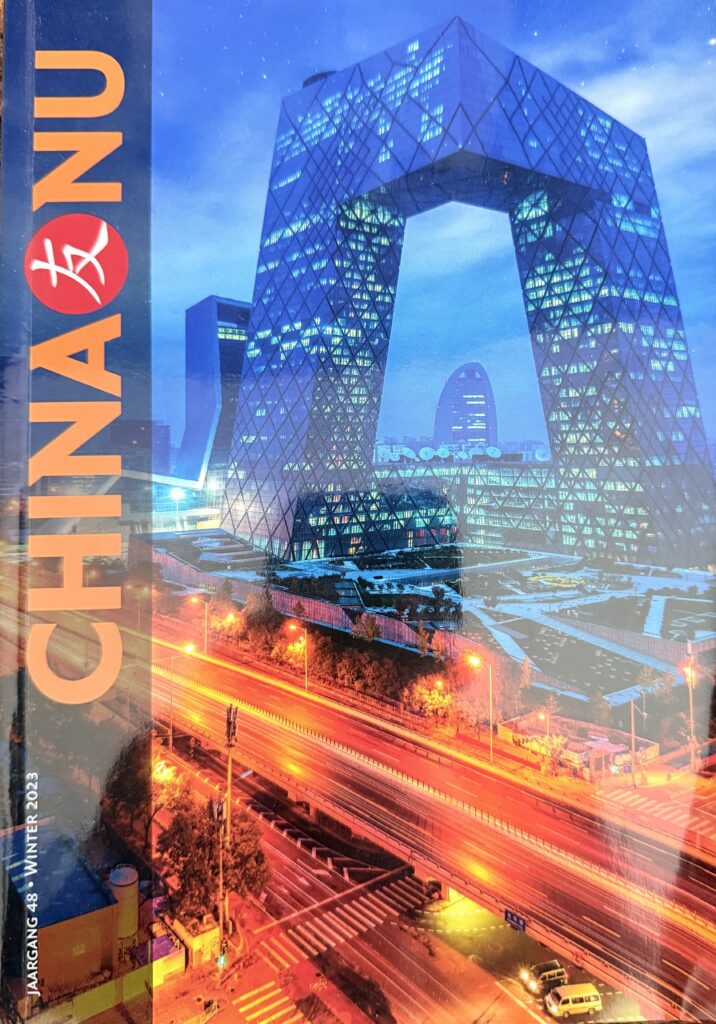
If you have been a member of VNC for a long time, you undoubtedly have a stack of China NU magazines lying around. It is a beautiful publication containing a wealth of information. In the run-up to the 50th anniversary, Jaap Post is reading through them all for ChinaNU+ and creating a highly readable summary. In this issue, we conclude the series with the years 46 through 48, covering the period 2021–2023.
The Future for Christians in China
The number of Christians in China is large, but they often do not have it easy. China NU reports that their number is estimated to be around 100 million. The vast majority are Protestants; The number of Catholics is between 10 and 12 million. Official 2018 figures are much lower, at 38 million Protestants and 8 million Catholics. The reason for that discrepancy is obvious: only members of government-recognized churches are counted, while millions of believers in so-called house churches remain outside the statistics. Because the faith community is growing rapidly, it is expected that China will have as many as 247 million Christians by 2030, which would make it the world leader.
Whether it will reach that point is questionable, as underground house churches are constantly under fire. Pastor Wang Yi and his congregation in Chengdu serve as an example. In addition to being a pastor, Wang Yi enjoys great fame as a human rights lawyer. The weekly magazine Nanfang Zhoumo listed him as one of the fifty most influential intellectuals as early as 2004. He is a man of action. During the devastating earthquake in Sichuan, he was one of the coordinators of private relief efforts. In 2017, the author attended an impressive church service in Chengdu. Nearly a thousand Chinese people gathered in a house church led by Pastor Wang Yi. Police were present, but they limited themselves to directing traffic. However, new laws and regulations have drastically restricted the freedom of house churches. In response, Wang Yi wrote a clear and unambiguous letter of objection. The following year, the police raided the church, and Wang Yi ended up in a prison cell. The church hall is now used by a construction company.
Is the Subject of Chinese a Keeper?
A new school subject does not always mean that it is here to stay. Italian and Russian – once popular new languages – are now only offered at a few schools. Will Chinese go the same way? Although China often receives negative publicity, the number of students choosing Chinese appears to remain stable at approximately 3,000, according to China NU. In this way, the subject makes an important contribution to increasing knowledge about China, which remains limited in the Netherlands.
In the 2017-2018 school year, the final exam for Chinese was offered for the first time at the VWO level. In HAVO education, people were longingly waiting for legal permission to include Chinese as a final exam subject. (Ed: As of the 2021-2022 school year, this is now also the case for HAVO.)
Technically, the subject is not called ‘Chinese language’ but ‘Chinese language and culture’. This is an important difference from other modern languages, which focus on language and literature, such as “French language and literature.” The goal of the culture curriculum is for students to develop a curious, open attitude. It is about learning to look at another culture without judging it, in order to gain more understanding and appreciation. A valuable skill that is just as important for people who are not studying or have not studied Chinese.
Mosuo Culture and Feminism in China
China possesses a rich culture with major regional differences. The centuries-old Mosuo culture is particularly unique: the Mosuo have a matriarchy, a form of society that only exists in a few places worldwide. The Mosuo live in a beautiful but geographically isolated area on the border between Yunnan and Sichuan. In this community, women hold the reins tightly. Both within the household and in economic affairs, they determine what needs to be done. For example, women have full control over their own land and property. Men play a more supporting role. A unique aspect of their society is the ‘walking marriage’. In this arrangement, a woman chooses her own partner, but unlike the patriarchal model, the man does not move in with her. Instead, he visits her at night and returns to his mother’s house during the day. Moreover, women can marry or have relationships with multiple men. When children are born, they receive the woman’s family name. Raising the children is handled by the mother and her family, regardless of who the biological father is. In the Mosuo language, there is not even a word for ‘father’; children address the men in their environment as ‘uncle’.
A fascinating book about this intriguing culture ‘The land of the daughters’ was published in 1997. The Mosuo culture has proven to be a source of inspiration for feminists and others striving for gender equality and alternative relationship structures.
Incidentally, much has changed since the book’s publication. Due to outside influences—such as better connections, increasing tourism, and government policy—the traditional way of life is under pressure. Although the culture of the Mosuo seems to be suffering the same fate as many other old traditions, it remains a powerful source of inspiration for Chinese women fighting for equality and independence.
Concrete Rot and Morality
Willingness to engage in charity is low in China. International research shows that the country belongs to a group of nations with a low inclination to donate to charities or help others. According to China Nu, the underlying cause lies in a profound lack of mutual trust within society. A long series of incidents has contributed to this. Think of the deadly tampering with baby milk powder, or the reuse of “gutter oil”—waste cooking oil from restaurants that is literally scooped from the gutter and resold to street vendors and eateries. There are also criminal gangs active in producing and trading fake vaccines. Add widespread corruption and bribery to that, and it is understandable that many wonder whether China is in a moral crisis.
According to the philosopher Jiwei Ci, this is related to the likelihood that norms and values within a society are upheld. That likelihood is highest when four conditions are met.
First, the imposed norm must be perceived as reasonably just. If that is not the case, civil disobedience looms.
Second, reciprocity is required: what one does for another, the other does for one. This is the biggest sticking point for China: there is a profound mistrust that others will follow the rules, and people lack confidence that the government will enforce those norms.
The third condition is the willingness to submit to the authority that establishes and enforces moral norms.
Finally, there must be role models who set a good example.
In China, authority and exemplary function are, in principle fulfilled by the government and the Party. But the authority that imposes the norms sets a bad example itself. According to Jiwei Ci, China is in a transition from utopianism (the communist ideal) through nihilism to hedonism. To the extent that there is still nostalgia for old values, it usually stems from a feeling of having been abandoned by the government. To what extent do we meet these conditions in the Netherlands?
The Chinese Legal System and Carl Schmitt
Het Chinese rechtssysteem is het oudste ter wereld, nog ouder dan het Romeinse en het Joodse recht. Net als het Romeinse systeem is het van oorsprong seculier. Het Chinese recht rust op twee filosofische stromingen met tegenovergestelde mensbeelden: het confucianisme en het legalisme. Het confucianisme gaat ervan uit dat de mens in wezen goed is; wetten zijn slechts bij uitzondering nodig wanneer individuen hun eigenbelang boven dat van de gemeenschap stellen. Het legalisme stelt daarentegen dat de mens van nature slecht is. Formele wetten en harde straffen zijn nodig om mensen moraal bij te brengen en de maatschappelijke orde te handhaven. In de praktijk leidt dit tot de effectieve stok-en-wortel-methode.
From the nineteenth century on, China also studied and incorporated Western legislation, in 1948 the existing Chinese legal system was pushed aside. The new rulers tried to set up a socialist legal system, which, however, collapsed completely during the Cultural Revolution. The reconstruction of the legal system only began again in 1979. Surprisingly, the work of the controversial German jurist Carl Schmitt played a major role in this, as China NU describes in an interesting article. According to Schmitt, it is possible for a government to make decisions that violate prevailing laws.
Schmitt’s own history was dark: he was a member of the NSDAP and supported the Enabling Act, which allowed Hitler to govern outside of parliament, even in violation with the constitution. He called the 1936 Nuremberg Laws a ‘constitution of freedom’ and he contributed to theories regarding the expansion of German territory in relation to culture, people, blood and soil. His ideas still resonate worldwide; for example, Steve Bannon, the former adviser to President Trump, finds his inspiration there.
In China, Schmitt’s work was translated around the beginning of this century, after which his ideas became common knowledge among jurists and academics in record time. The practical influence of this also became apparent during the introduction of the National Security Act in Hong Kong, with which the promised fifty-years of legal autonomy came to a premature end. In defense of this harsh intervention, Schmitt was openly quoted: “The sovereign decides when the law must yield to state security.”
Jaap Post has been a VNC member since 2000, chairman from 2001 to 2008, and is currently advisor to the board and member of the Committee of Recommendation