Interview with Sinologist and cookbook author Alice de Jong
by Marilou den Outer
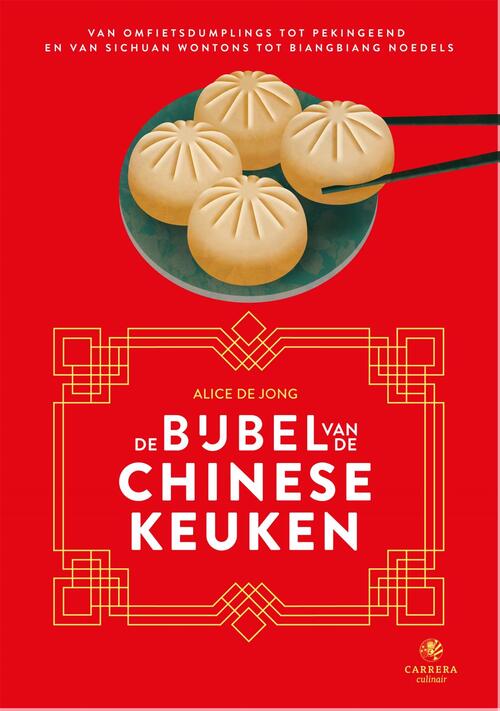
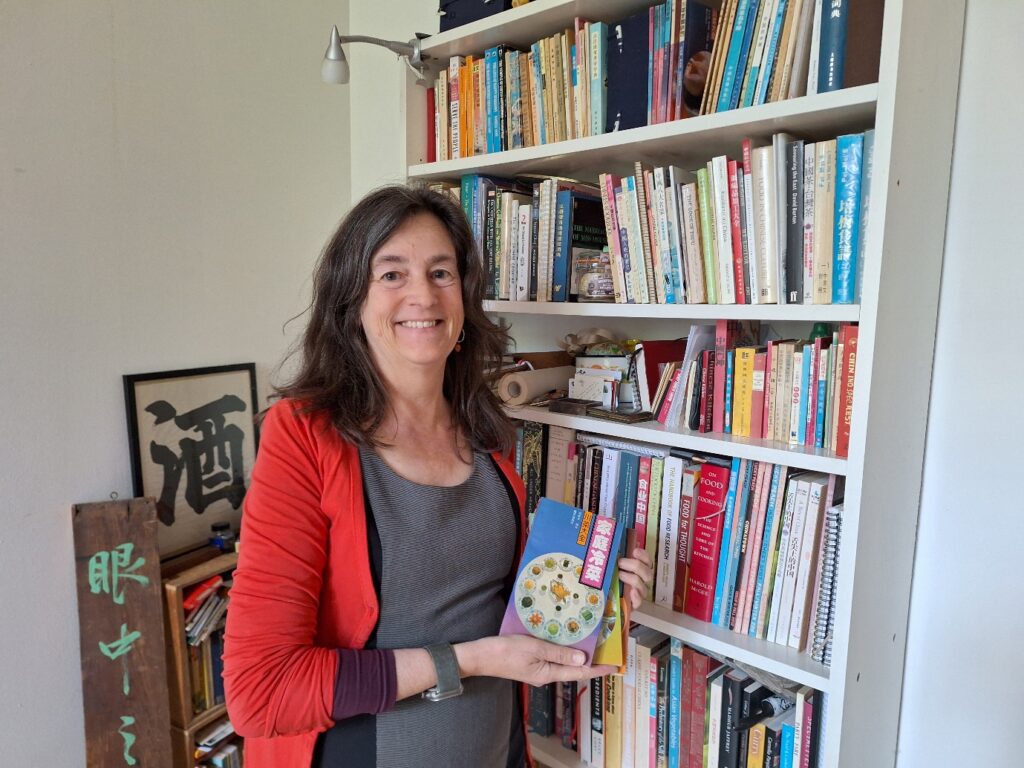
This year, De bijbel van de Chinese keuken (The Bible of Chinese Cuisine) was released as part of the popular ‘culinary bible’ series by publisher Carrera Culinair. The author is Sinologist Alice de Jong, who began collecting Chinese cookbooks as early as the 1990s. Back then, she even wrote a cookbook of her own – for her friends. Now, we have this massive Chinese culinary bible, which has already sold two thousand copies in just three months. To her own pleasant surprise: “It’s wonderful, I really didn’t expect that!” At the large dining table in her apartment in the center of Leiden, we learn about Alice’s fascination with Chinese food and, above all, how to prepare it yourself. She tells us how this book came to be and the choices she made along the way.
In the footsteps of Fuchsia Dunlop
Throughout all the years Alice has been visiting China, she has built up an enormous collection of cookbooks, including centuries-old source texts. She has also attended various workshops there. For instance, in 2010 in Chengdu (Sichuan), she took a several-week course to get to the heart of Chuancai, the cuisine of Sichuan. It was the exact same school that the renowned Fuchsia Dunlop had attended before her. Since 2001, this British author was the first to put Sichuan cuisine on the map in the West with her award-winning cookbooks.
Alice: “I was desperate to go there, of course! That’s how I ended up at a culinary institute among a few thousand young students – the Sichuan Institute of Higher Cuisine, a top-tier academy. We were taught in a small group of foreigners and learned, for example, that there are as many as 23 flavor profiles in Sichuan cuisine, with the flavor of the dish mapo doufu being one of them. In the culinary bible, I describe what I experienced there, but I didn’t include all those nuances in the book’s recipes; that would be going too far for the home cook,” Alice laughs.
Not cuisines, but regions
According to the standard Chinese classification, there are four or eight Chinese ‘cuisines’. Lǔ cài , for example, refers to the Shandong region. Alice: “That is often difficult for outsiders to grasp. That’s why I opted for a regional approach in the culinary bible. Six regions: north, east, south, west, northeast, northwest. Within these, I cover 22 cities, with ten recipes per city. That provided the structure. I first looked at the most famous dish, for instance, the soup noodles from Guilin, and searched for more recipes to go with it. In Kunming (Yunnan cuisine), recipes featuring fresh mushrooms and bamboo take center stage.”
Reproducible in the Western kitchen
It is important to Alice that the dishes can be prepared in an average Western kitchen. For this reason, dishes like the famous steamed freshwater fish Xīhú cùyú from Hangzhou (Zhejiang) did not make it into the book. The black Changsha chòu dòufu (stinky tofu from Hunan) also proved too complex in practice. However, Alice did include the sauce – the broth – from that dish in the book, so it can be prepared using the tofu familiar to us. Without the black color, that is. A recipe to make your own tofu is included in the book, as are recipes for dumpling wrappers and noodles.
A fan of dough products from northern regions
On the other hand, she certainly does not shy away from challenges for the reader. What about ‘steamed oat tubes’, a paste made of oat flour, rolled into a sort of cannelloni shape? Alice: “A recipe I had heard of, but had no idea how to make. It was a really fun task to figure that out. Just like the ‘three-layer pasta’ from Taiyuan: first a layer of wheat flour, then a layer of sorghum flour and finally wheat again. Delicious! I am, by the way, a huge fan of pasta from the northern regions.”
A well-known northern region is Lanzhou, the capital of Gansu. In 2019, Alice followed an intensive noodle chef training course there. “A truly Chinese education. Classes continued even on weekends; it was very intensive, and we slept in the dormitory. We not only learned to pull noodles by hand but also how to prepare soup and other side dishes.”
All of China is eating spicier
In recent years, numerous Xi’an and Lanzhou-style noodle eateries have been popping up in the West, often run by Chinese chains. Many people are now familiar with the famous, wide and hand-drawn Biángbiángmiàn 𰻝𰻝面 noodles from Shaanxi. Those dishes can also be quite spicy.
Alice has noticed that, in general, people in China have started eating spicier food in recent years. “In the past, cuisines remained primarily local. But now, there are many migrant workers traveling all over the country in search of work. They bring their own flavors to the areas where they end up, which is making the restaurant landscape much more diverse everywhere. Sichuan cuisine in particular has caught on nationwide; hence the trend of eating spicier.”
Back to the culinary bible: it contains no fewer than 230 recipes (you can find one at the bottom of this article) and a concise history of Chinese cuisines. Alice publishes a more extensive version of that history on her Substack Big Biang Café https://alicedejong.substack.com/
(longread) https://alicedejong.substack.com/p/een-korte-geschiedenis-van-de-chinese
Anyone who has been cooking Chinese food for some time will undoubtedly knows Alice from Tokowijzer.nl https://tokowijzer.nl/ the platform where she shares all her knowledge about Asian grocery stores and the ingredients available there.
Another interview with Alice can be heard in the podcast Watschaftdepodcast.com (ep. 190) https://watschaftdepodcast.com/podcasts/
———————-
De Bijbel van de Chinese Keuken (The Bible of Chinese Cuisine), by Alice de Jong. 496 pages. Publisher: Carrera Culinair.
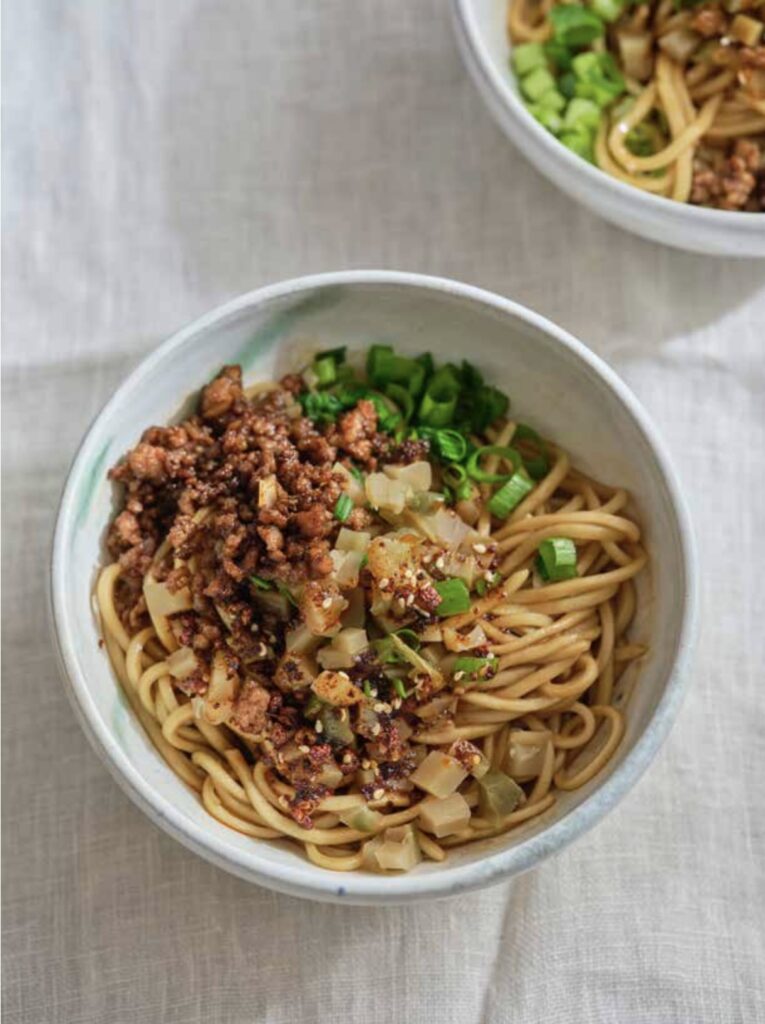
RECIPE: Sesam Noodles
regan mian 热干面
This is the most famous noodle dish from Wuhan, where millions of people eat it for breakfast. The noodles have an ostensibly simple sesame sauce, but it is addictively delicious, and the texture is also quite unique. In Wuhan, we ordered these noodles every day and spooned extra toppings onto the noodles at the ‘sauce station’.
Ingredients:
FOR THE SPICE WATER:
1 star anise
1 small piece of dried tangerine peel (chenpi)
4 bay leaves
1 black cardamom pod (caoguo), halved and seeds removed
1 small piece of cinnamon bark (cassia)
1 tbsp whole Sichuan peppercorns
pinch of salt
pinch of sugar
1 tbsp dark soy sauce
FOR THE SESAME MIXTURE:
60 g sesame paste or tahini
40 g sesame oil
PER PERSON / PER BOWL
110 g fresh alkali noodles (or ramen noodles)
1 tbsp oil (or more) to toss the noodles
1 tbsp soy sauce
1/2 tbsp dark soy sauce
1 tsp Chinese black vinegar
pinch of salt
1 tbsp of the spice water (from step 1)
2 tbsp of the sesame mixture (from step 2)
GARNISH:
2 tbsp pickled daikon, diced
1 tbsp spring onions, sliced into rings
1 tbsp chili oil or more to taste
Put 300 ml of water in a saucepan and add the star anise, tangerine peel, bay leaves, black cardamom, cinnamon bark, Sichuan peppercorns, salt, sugar, and soy sauce. Bring to a boil, turn off the heat, and let it steep for 15 minutes. Pour the mixture through a sieve into a small bowl. Your spice water is ready. If this feels like too much work, you can replace the spice water with plain water mixed with a little bouillon powder.
Whisk the sesame paste with the sesame oil until you have a smooth sauce and set aside: this is the sesame mixture.
Bring a large pot of water to a boil and cook the noodles until they are very al dente. Spread them out on a work surface and separate them while they are still hot. For this, use two long chopsticks or two ladles. Pour a teaspoon of oil over the noodles as you lift them and let them fall back down. Through this process, the noodles cool down quickly and acquire their beloved chewy texture. Do this until the noodles no longer stick and feel dry. Set aside under a tea towel until use.
Prepare the bowls: for each bowl, measure out the correct amount of dark soy sauce, Chinese black vinegar, salt, spice water, and the sesame mixture.
Just before eating, reheat the portions of noodles in plenty of boiling water for 20 to 30 seconds until they are hot and cooked through. Place each portion in a bowl and mix immediately with the sauce. Garnish the noodles with diced daikon and sliced spring onions. Spoon chili oil over them to taste.
Source: Alice de Jong. De Bijbel van de Chinese Keuken, pp. 209-210 (Carrera Culinair, 2026)