by Astrid Bouwman
After a break of several months, there was another edition of the VNC eating club on December 12. This time in Leiden, at restaurant Asian Palace. This time, the call had brought together a full table of twelve lovers of Cantonese food from all over the country.
Before the bowls appeared on the table, Oey Toen Ping, organizer and host, naturally wanted to show something again. In doing so, he told a tasty story.
Ping took us back to China in the last century, where he wanted to accelerate his command of Chinese in 1979 with a summer course in Beijing. It seemed to him that the joint lunches with international fellow students did not contribute to this and so he stepped out into the street and found a stall where dumplings were sold. There he paid, but that turned out not to be enough, it was asked liangpiao . His student card? His passport? Ping turned out not to have what he was looking for. After some consultation behind the stall, he got his plate of dumplings. In consultation with a teacher, Ping learned that flour coupons were requested. Fortunately, he had friends who had enough, so that Ping could hand over the requested voucher on the street from now on. He has never forgotten this word and actually it has not let him go.
He has studied the system of distribution coupons and started collecting coupons. He has brought two stamp books with his private collection for us. One book with flour coupons, a second with coupons for various basic products such as cotton, yarn, cooking oil, pork, soap and sugar.

In the 1980s, China was still a poor country and used a nationwide distribution system to distribute daily food and consumer goods fairly. It was a layered organization in which each city, factory, university, had its own coupons, the amount of which was determined annually. Each household had a booklet containing the name of the head of the family and the number of people, because that determined the amount of coupons. There were also national vouchers for when you had to travel for work. Excluded from vouchers were the trolleys at the train stations that had to provide passengers with food and drinks. The system was introduced in the mid-fifties and only officially and nationally abolished in 1994.
Fortunately, there were no signs of scarcity tonight and we were able to sit down without liangpiao and enjoy Ping’s meal choice.
The opening was spectacular; steamed scallops, hidden in a bed of thin rice noodles, spring onion and crispy fried garlic. This was followed by a richly filled seafood soup. The tone was set.
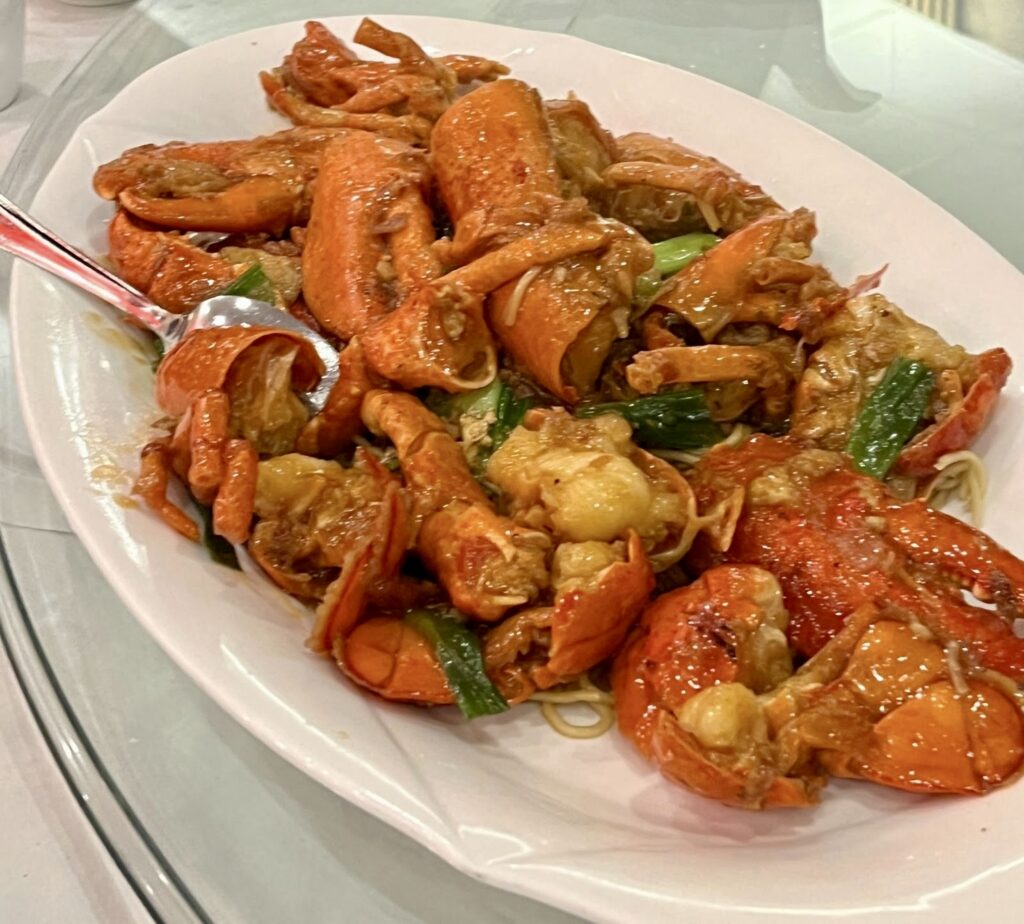
The next round brought a platter of green asparagus, macadamias and squid, a platter of beef and finely sliced onion, red and green peppers – and the showstopper – lobster, for shape on a bed of noodles, but who cares about that when deliciously juicy bite-sized pieces of lobster present themselves?
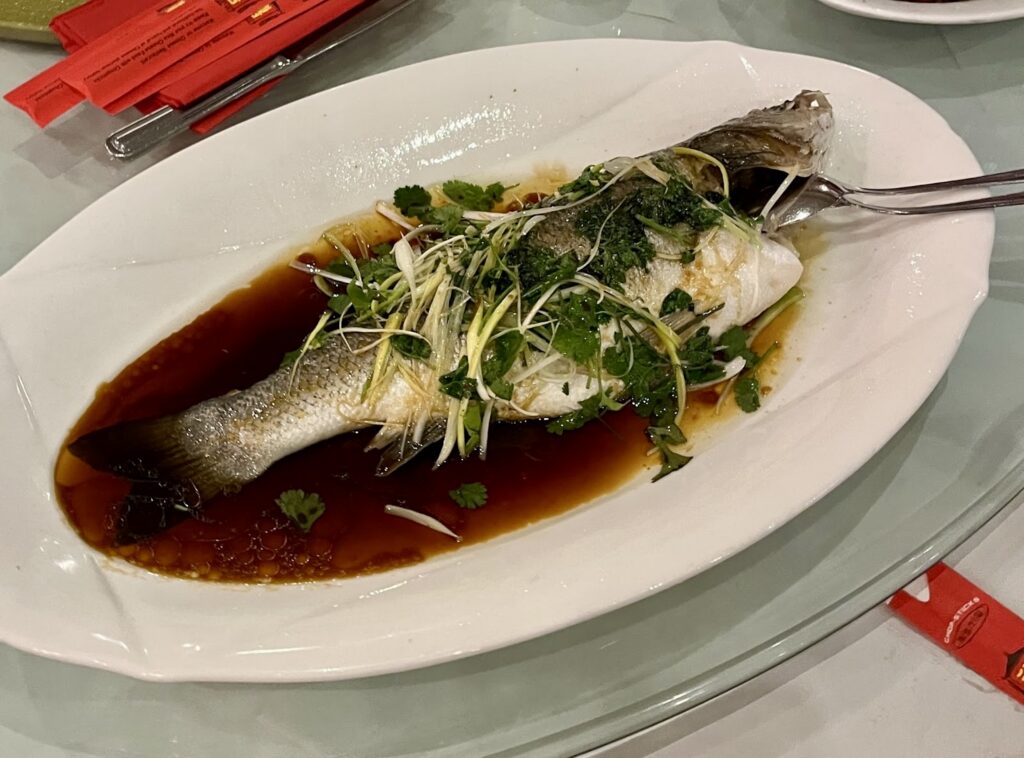
A steamed grass carp, decorated with strings of spring onion, swimming in soy sauce, disappeared remarkably quickly, until only the bone and head remained.
The roasted Canton duck was beautiful in color and delicious in taste, firm and with a crispy skin. The chicken, not skinned, also chopped into chunks, right through the bone, had a delicious salsa of garlic and ginger to spice up the bare chicken.
For variation a bowl, bright green and vegetarian, of coarsely chopped and stir-fried jiecai, Chinese mustard cabbage. Very fresh, slightly bitter taste, good for a change from the hearty meat dishes. The next dish was an exuberantly colored mix of green (sugar snap peas), orange (carrot), brown (fried slices of beef) in a bed of curly noodles. The surprise lay in the noodles, which turned out to be fried and crunchy. The fried rice, also with beef and large shrimps, was almost ordinary. The large plate of fruit was a fresh end to the meal full of flavor textures and variations. The twelve dishes, not counting many bowls of rice and liters of tea, were very much appreciated by everyone.
Because the dining club was placed in the back of the restaurant and could dine completely undisturbed by other guests, this time it was possible to have table round conversations and get to know each other better. We hope to bring together people who have something to do with China in the new year, VNC member or not, everyone is welcome. Ping does not want to reveal which kitchens we will visit then, but he does want to tell and show something about the woodblock printing technique and New Year’s prints in January. In February it will be about the Chinese calendar and zodiac. Keep an eye on the VNC newsletter!