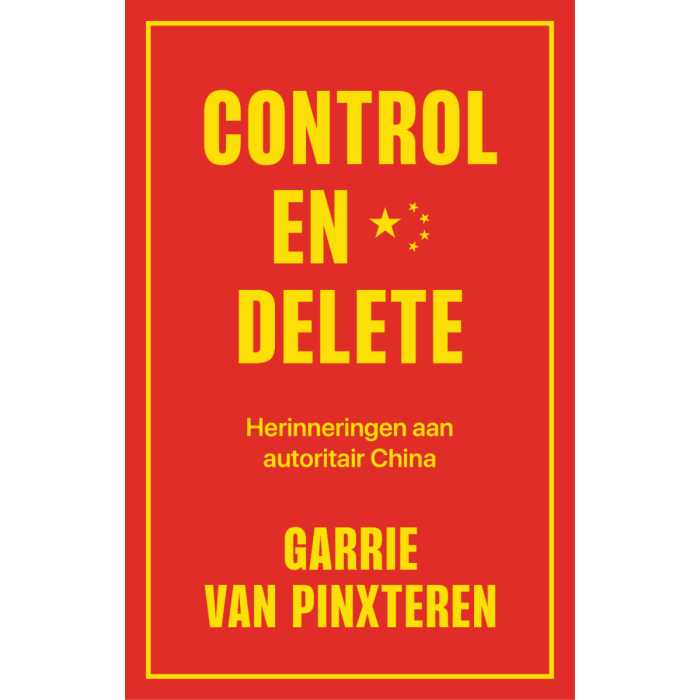
VNC/LAC Book Launch Control and Delete by Garrie van Pinxteren
by Astrid Bouwman
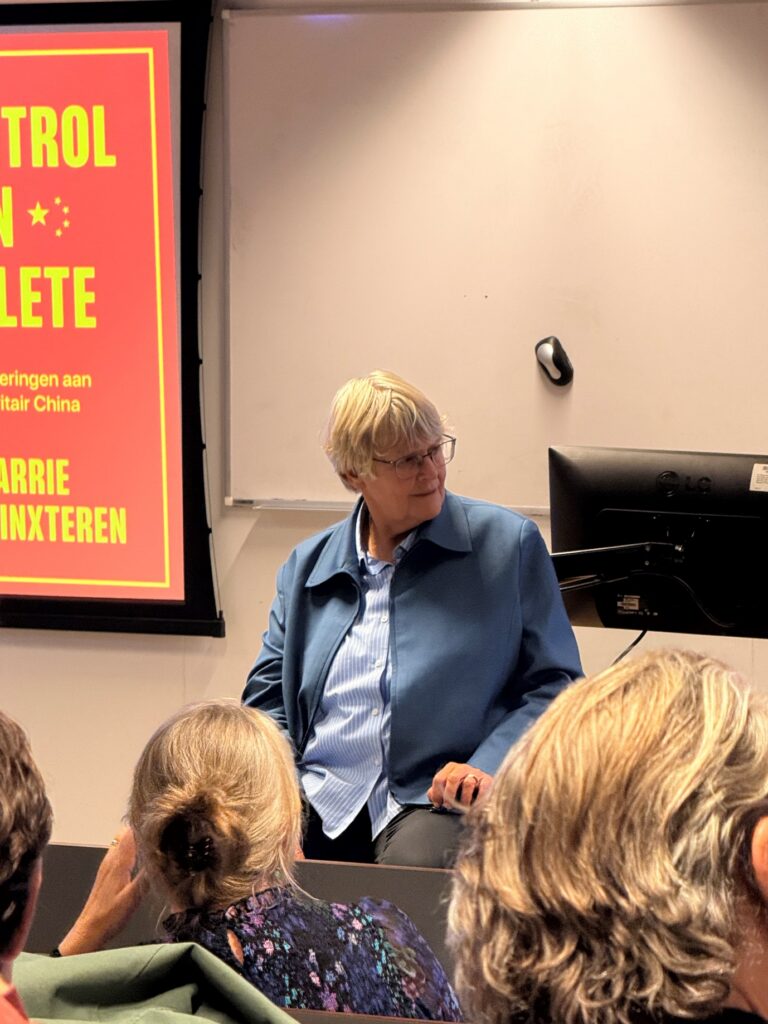
After a word of welcome by Monique Knapen (chair VNC) and an introduction by moderator Floris Harm (director LAC), the floor was given to the recently retired NRC China correspondent Garrie van Pinxteren. The evening was dedicated to her recently published book Control and Delete.
“I almost get a reunion feeling”. With these words, Garrie opened the evening. She was back at her old alma mater, this time not in the lecture halls but in front of a full house. This turned out to be a diverse group of VNC members, LAC followers, scientists, employees of ministries and fellow journalists with the common denominator being the interest in China. A lively debate soon ensued, in which Garrie’s story was supplemented with observations and experiences from the audience. After 45 years, Garrie comes home with a dark message.
An attempt to save what can be saved
Garrie noticed that her farewell essay in NRC (late 2023), – a personal review over a longer period of time – resonated a lot. The publisher then proposed to write a book: “More than the stories in the newspaper, this book offered the opportunity to make a personal analysis of what I have actually seen over the years, what it means. I have tried to make the complex, big story palpable, all the more so because the freedom to tell these kinds of stories is under pressure in China itself; an attempt to save what can be saved.”
Correspondent with a personal story
Garrie has always enjoyed the journalistic field: The hidden nature of China and the fact that “nothing is what it seems” was a true Valhalla for her: “I noticed that people want to ‘confess’ once you’re inside. Unfortunately, the space to discover those stories disappears more and more and at some point, despite your journalistic toolbox, you hit a hard wall. Caution and even caution to protect sources from the Chinese government is essential. A tourist will see beautiful China, modern, safe, clean, and not come into contact with the hard, painful side and find it hard to believe that it is there. For that, you must have experienced the oppressive feeling of lack of freedom.”
Garrie enthusiastically responds to the question of whether she can still remember her arrival in China. She remembers what the airport looked like, the pale colors of the arrivals hall and the oversized Mao uniform of a soldier, the slow-motion movements of people along the road (a pace she later only saw in North Korea).
Social changes
Asked about the fundamental changes for the people in China she has been able to observe, Garrie quickly sums up: “The diversity in opinions and social groups has increased, people are better informed, they have seen more of the world, they have become world citizens, prosperity has increased, there is greater freedom in study and career choice.” She remembers that plastic bags were washed for reuse, that many products were on coupons, that there was scarcity and poverty.” The differences between rich and poor have widened, people have become more individualistic, and with it the social cohesion between neighbors and friends has decreased, as well as the belief in communist society.”
Security over privacy
From the audience comes the question of how we should look at China. When this is done with Dutch eyes, it gives a wrong picture, for example when it comes to privacy. In the Netherlands that is one thing, but in China security is more important than privacy. Garrie indicates that she looks at China with those Dutch eyes, because she has to make the translation: “I am looking for what is peculiar to us and try to describe it. I will be successful if I know how to tell what the Chinese side is.”
The future of authoritarian China
Garrie witnessed the freer of Chinese society in the 80s and saw that since 2012 the strings were tightened again. Currently, we see China as an authoritarian state. Which way is China going; Will it be more open or dense?
Garrie does not want to call himself an oracle but thinks that the society orchestrated by Xi Jinping will find it difficult to loosen up again after his departure. Although the social and economic development is enormous, this is less and less in line with the one-party system: “Yet this is the only way to get ahead in your career, so if you are ambitious then you follow that line. But the corona epidemic has also taught us that sticking to ‘line’ for too long works up to a certain point and no further, then things explode.”
Has she become more critical of China? No, she doesn’t think so. In the long time she was in China, freedom has increased and shrunk again.
The relationship between Europe and China
As far as geopolitical tensions are concerned, Garrie certainly thinks a China-critical debate is useful. She states that currently the threat from China is greater than the Russian one. She cites a number of arguments for this. The war close to our borders will only last so long because of Chinese support for Russia. What China says in international forums is not what they say internally. Based on the Chinese plans and policy documents, there is every reason for caution and fear. In the Dutch debate, little or no use is made of this kind of available information, more substantiation is needed.
For a long time, there has been European naivety towards China. But China’s stance in international relations is harsh, they don’t believe in comparative advantage, the idea of fair exchange with win-win as a result. From the audience it is added that Europe has long but in vain bet on this so-called deaf dialogue, but has had to discover that China is not listening.
When asked whether we can assume that China’s power is still growing, Garrie cannot give a ready-made answer. China’s international influence is still increasing – that is what Xi Jinping is betting on – but the internal economy is stagnating. The published growth figures probably paint too positive a picture. And it is clear that domestic consumption and prosperity are lagging far behind.
Extremes in the news
The negative coverage of China is extensively reported in the media. Spectres are evoked about Chinese surveillance, but that is not a uniquely Chinese phenomenon, the perspective is lacking. Attendees from the business ‘corner’ think that we lose sight of what we can learn from China, what is good or useful for us.
Garrie agrees with one speaker that there is less coverage of China than of America; “The premier of China, for example, is unknown here. Due to the emphasis on geopolitics, the ‘small’ news is not covered. The possibilities of getting hold of that are also decreasing. A conversation on the record is becoming increasingly difficult.”
One of the correspondents present is struggling with the dilemma of the ‘good news show’. He wonders whether an article that paints a different picture than that of the threatening cloud will be read. To what extent are you, as a journalist, responsible for forming the opinion of the reading public?
Garrie believes that as a journalist you do bear some responsibility, but that in the end you have little influence on your readers. She has noticed that readers remember her human stories, but also that they can interpret stories differently than she intended. As a journalist, you can’t single-handedly complement the picture: “That’s why it’s so important to have a diverse press, which can express different points of view. Readers should be able to look for a variety of sources themselves.”
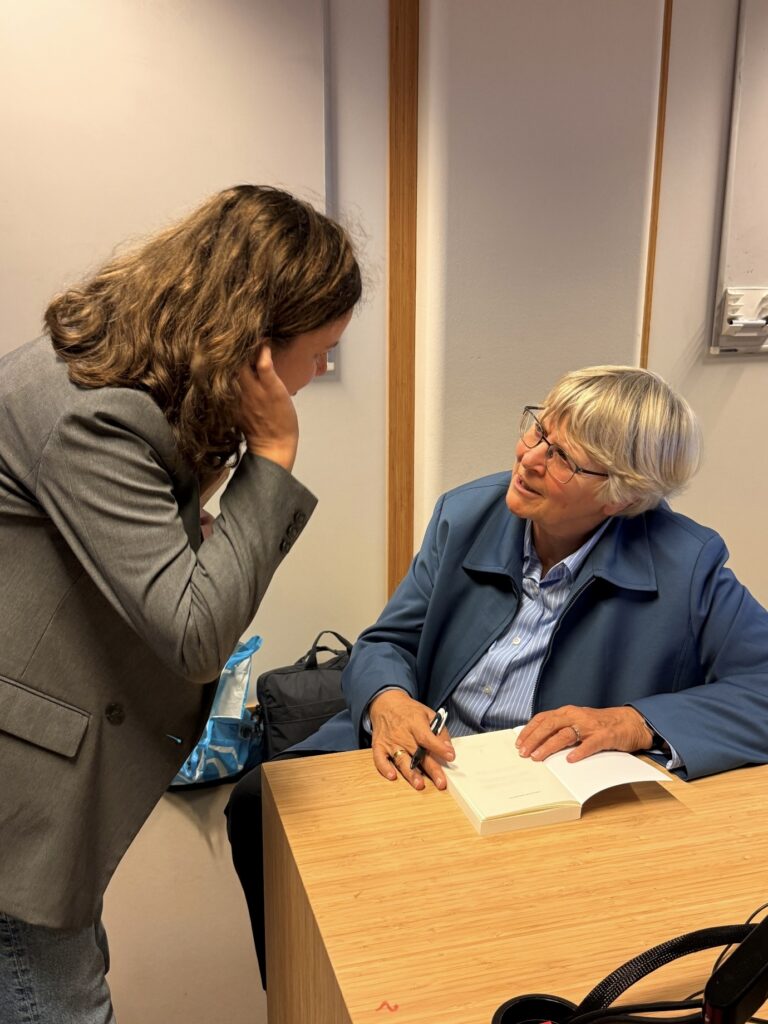
After an hour and a half, not all questions had been answered, but the time was up. It was an interesting, interactive and intimate evening, in which Garrie’s book really only served as a pretext. Afterwards, the pile of books quickly disappeared, and I too will soon sit down quietly to read Control and Delete from start to finish.
—————————-
Book Information:
Control and Delete, by Garrie van Pinxteren, 304 pages. ; Pluim Publishers, isbn 9789493525221, price 24.99