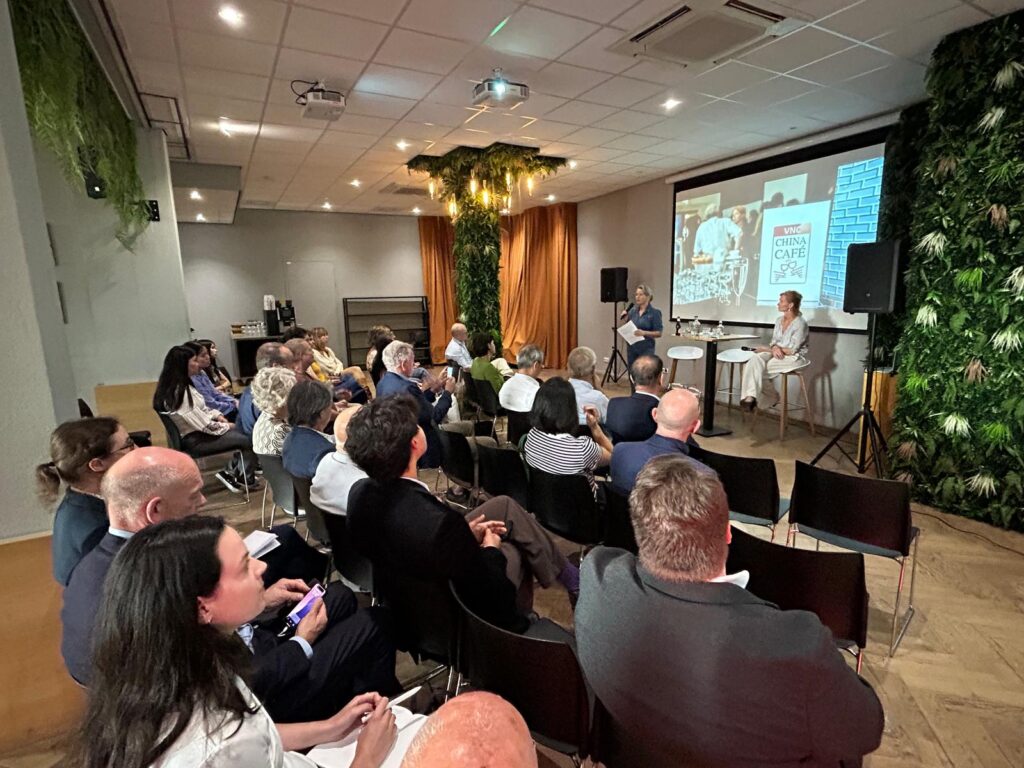
On September 8, the China Café once again took place at the Stadsbrasserie in Utrecht, bringing together professionals, students, and China enthusiasts. This edition focused on the timely and complex topic of Corporate Social Responsibility (CSR) in China. The guest speaker was Valérie Hoeks, strategy advisor and founder of China Inroads, who has more than 20 years of experience working with European companies in China. She was interviewed by Lianne Baaij, board member of the VNC (Vereniging Nederland-China).
CSR in the Chinese Context
While CSR has long been a key theme in the West, it is gaining remarkable traction in China. Stricter environmental regulations, growing attention to workers’ rights, and the rise of ESG reporting are clear indicators of this shift. Yet, as Valérie explained, the well-known Western CSR framework plays out very differently in China.
CSR in China is strongly linked to the government’s broader societal goals. The concept of 和谐社会 (héxié shèhuì, “harmonious society “*) reflects the top-down approach, where stability and collective well-being are prioritized. In contrast, the Western approach relies more on bottom-up accountability, driven by transparency, reporting standards, and pressure from multiple stakeholders such as NGOs, media, and consumers.
Why Chinese Companies Embrace CSR
China is undergoing a transition from the “world’s factory” to an innovation-driven society. Several factors motivate Chinese companies to embed CSR in their strategies:
- Rising domestic expectations – Chinese consumers increasingly demand higher quality and responsibility.
- The power of social media – Online criticism can quickly escalate and pressure companies into action.
- International regulations – Export-oriented firms must comply with stricter Western CSR and ESG requirements (such as CSRD).
Unlike many Western firms that treat CSR as a separate activity, Chinese companies tend to integrate CSR into their business plans, focusing on visible, tangible results. Western companies, by contrast, often emphasize metrics and reporting. This difference can create tension between European headquarters and local Chinese management.
Bridging the Gap: Dual Compliance
Valérie’s company, China Inroads, helps Western companies to localize in China, for example by developing dual compliance frameworks. These frameworks help firms navigate both Western and Chinese expectations, ensuring they can communicate effectively with diverse stakeholders. Often, Valérie helps companies establish a special China Taskforce to coordinate such cross-border efforts.
Philips was highlighted as a strong example of a company that balances global CSR governance with local responsibilities in China. Meanwhile, H&M suffered reputational damage when it announced it would stop sourcing cotton from Xinjiang without consulting its Chinese team-a decision that sparked backlash.
The Reverse Challenge: Chinese Companies in Europe
Just as Western companies face difficulties in China, Chinese firms encounter CSR-related challenges in Europe. Companies like Huawei and BYD struggle with transparency demands, particularly on labor rights and human rights. To build trust, many are increasingly hiring local staff and engaging with local community initiatives, including supporting Chinese diaspora groups.
Looking Ahead
As Valérie emphasized, CSR in China is deeply tied to national priorities and is not seen as an add-on but as part of a company’s core business strategy. Moving forward, green financing and social stability will be key drivers shaping CSR practices.
The evening at China Café underlined a crucial insight: while CSR frameworks differ between China and the West, both are ultimately striving toward the same goal-responsible business that balances profit with people and the planet.