Monique Knapen
After a typical Shanghainese dinner, I ordered a taxi through my app. Chatting along the way, we drove to the Shanghai University of Sports where I was staying with a group of table tennis players for two weeks. The taxi’s dashboard was crammed with little figurines, and with two phones mounted on the holder, the driver looked like a pilot in a cockpit. Almost all taxi drivers are men, but this one had a strikingly high-pitched voice. Only after a while did I realize that this driver was a woman.
The next day I had to head out early, but with a typhoon approaching I asked the driver if I could pre-book a ride through my travel app. She offered to pick me up herself, with a 20% discount, money she would otherwise lose to the app provider. It seemed like a fair deal to me. We talked some more about her work. She only drove in the mornings between 7–11 and evenings from 5–11, never on weekends because that’s when she played online mahjong. She had once run a restaurant, but during the pandemic it went bankrupt, leaving her with heavy losses. Since then her car has been her ‘castle’, with which she deftly maneuvers through Shanghai, earns her living, and repays her bank loan. Incidentally, she makes more money playing mahjong than from driving passengers around the city.
As I got out, I noticed a sticker of a little creature on the door.
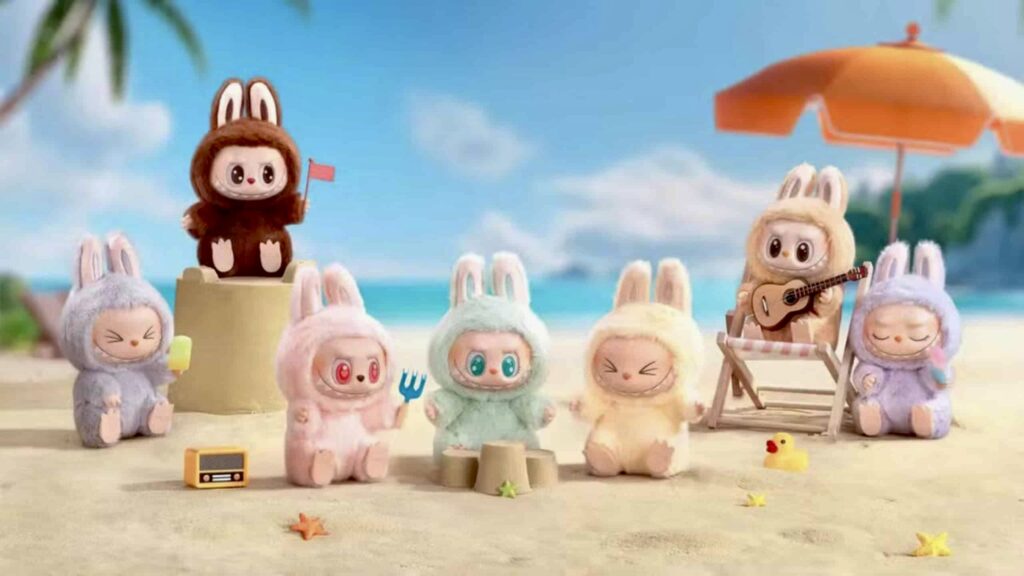
The following day she arrived right on time to pick me up. I gave her a package of stroopwafels, a standard part of my gift repertoire in China. She also had a gift for me: a Labubu. It was a figurine, a small monster, the same one I’d seen on the sticker. I had never heard of it before, but it turned out to be a huge global craze. Everyone I asked about it later knew exactly what Labubu was. Labubu stands for “being yourself” versus “fake smiles.” They’re cute, and most importantly: collectible. Plenty of reasons to want one for my nine-year-old grandchild. She even sent me a picture of her own Labubu; so she already had one! Apparently it’s a TikTok sensation, so the whole world knows about it, except boomers like me.
On her advice I went to a Popmart store to buy a Labubu. Unfortunately, they were sold out. Instead, I found creatures with names like Hirono Beer, Dimo, Gong, and various other families of fantasy plush toys. Some come in sealed boxes, so you don’t know what you’ve bought until you open it. They’re collectibles, a bit like when we used to collect football cards that came for free with groceries.
Later that week in Beijing, I met up with a friend who had a collection of no fewer than 25 of these monsters. She collects them for the fun of it, because they make her feel good, and she finds them affordable (99 yuan, about €12.50 each). Together we each bought a surprise box at Popmart; she for her collection, I for my grandchild.
From her – and online – I learned more about Labubu and Popmart. Labubu is the creation of well-known Hong Kong artist Kasing Lung. Kasing grew up in the Netherlands, where he loved comic and picture books. They helped him learn Dutch and became the source of his creativity and passion for illustration. He illustrated several children’s books without ever breaking through, until toy company How2work asked him to bring his characters to life in 3D collectible figurines. The leap from illustrator to toy designer proved to be a turning point in his career. Meanwhile, Kasing continued illustrating his own books, and with The Monster Trilogy Labubu and his ‘gang’ were born. Labubu only became truly famous when it was included in Popmart’s collection.
Popmart is a Chinese company specializing in artsy toys, figurines, and trendy collectibles. Popmart now has stores and online outlets worldwide, including in Amsterdam’s Kalverstraat. The company’s growth shows no sign of slowing. It targets children, as well as ‘kidults’ – a merger of kids and adults. Young women in particular love the colorful, furry creatures.
Popmart’s main marketing trick is the blind box: it’s a surprise which figure you’ve bought, and perhaps you’ll get a special hidden edition. To qualify for these, you need to buy multiple boxes beforehand. New and rare characters are constantly released, fueling the urge to keep collecting. Some Labubus sell online for more than twenty times their original price.
Popmart collaborates with local powerhouses, in the Netherlands even with the Van Gogh Museum. Social media, influencers, and film stars showing off Labubus clipped to their belts or bags play a big role in the brand’s success. And if you’re a real fan, Popland – the Popmart theme park in Beijing – is a must.
For the record, I never actually saw anyone carrying a Labubu around, but maybe I just missed the influencers, or maybe people keep them safely at home on display.
Back in Shanghai, I rode again with “my” taxi driver. This time she handed me another Labubu for my grandchild. A friend of hers in Ningbo had a spare and sent it over without my knowledge. I wasn’t allowed to pay a thing. Next time I’ll bring her a Miffy.