The underreported dark side of China’s economic growth
by Aldo Spaanjaars
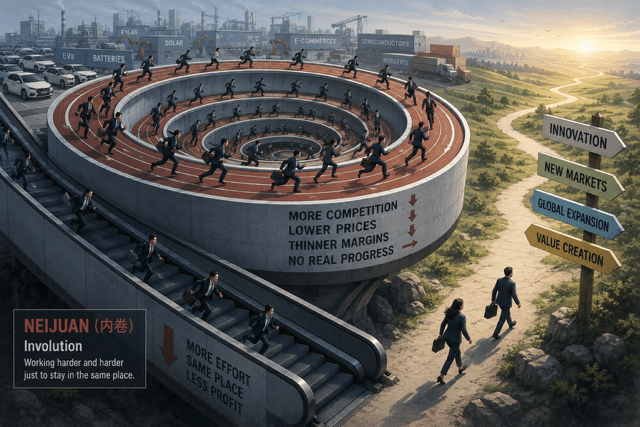
China’s economic success story has a downside that until recently remained underreported. Under the banner of neijuan (内卷)– literally ‘involution’ – a paradoxical crisis is unfolding: despite enormous innovative power and capital, price wars and overcapacity are eroding profitability in key sectors such as the EV market.
As the domestic market becomes saturated, Chinese companies are exporting this extreme competitive pressure to Europe. For the EU, understanding these dynamics is an absolute necessity. Those who attributes the rise of Chinese companies purely to state subsidies and geopolitical strategy underestimate the operational clout of a competitor forged in the world’s most demanding arena.
China’s ‘Neijuan’ Economy: When Competition Undermines Itself
For decades, China’s economic narrative has been one of relentless competition. The word ‘hyper-competition’ captures the pressures that dominates many sectors. Yet even by Chinese standards, things are getting out of hand, and a new word has permeated boardrooms, media debates and even official speeches for months: neijuan.
Often translated as “involution,” neijuandescribes a situation where competition is so intense that efforts increase, but value creation stagnates. Simply put: everyone works harder and invests more, but margins shrink, innovation risks turning into imitation, and there are no winners. It is a downward spiral. This is not Western criticism, but an ongoing domestic discussion within China – and one that is vital for us to understand.
What is Neijuan in Business Terms?
Originally a sociological concept (think of the rat race driven by rising university admission requirements where everyone studies harder, but no one gains a relative advantage), neijuan has now evolved into a buzzword for the business world. It generally refers to:
- Price wars that undermine profitability
- Endless products upgrades that add no real value
- Overinvestment in the same sectors
- ‘Growth at all cost’ strategies that destroy capital
Recent examples are easy to find. China’s electric vehicle (EV) sector has seen aggressive price cuts over the past two years, led by major players like BYD and followed by dozens of competitors. According to industry data from Caixin and The Financial Times, among others, price cuts have squeezed margins across the industry, despite rising sales volumes.
Industries such as food delivery, local service platforms, and livestream e-commerce are also locked in a price wars, burning capital to win users in already saturated markets; an exhausting race to the bottom.
Involutionis not caused by a lack of innovation; on the contrary, China remains fiercely innovative. However, neijuan describes precisely what happens when too many capable players compete in the same sector: operational intensity increases and profitability collapses, without the total value pool growing any further.
Why Did Neijuan Emerge?
Three structural factors explain this phenomenon. First, economic growth has moderated compared to the double-digit figures of the past, increasing competition for existing market shares.
Second, industrial capacity has been built up on a massive scale over the past two decades in sectors such as EVs, solar panels, batteries, and consumer electronics. This capacity is difficult to keep profitable when demand stagnates.
Third, local governments have long supported the same strategic sectors, leading to clusters of parallel-competing companies that generates severe overcapacity.
The result is paradoxical: China’s strengths – scale, speed, talent, capital – simultaneously create the conditions for destructive competition.
From Speed to High-Quality Development
Policymakers and media in China now widely acknowledge the problem. Official statements and state media commentaries openly criticize “disorderly competition” (无序竞争, Wú xù jìngzhēng) and excessive price wars. To turn the tide, the Chinese leadership is increasingly emphasizing ‘high-quality development’ (高质量发展, Gāo zhìliàng fāzhǎn).
The message is clear: the focus must shift from pure quantitative growth to profitability, technological depth and resilience. To this end, specific anti-involution measures have been formulated, such as regulating over-aggressive pricing policies and encouraging ‘orderly bankruptcies’. Nevertheless, the central authorities have so far failed to solve the fundamental problem. Many unproductive companies stay afloat thanks to local bank support or government subsidies, which continues to hinder much-needed market consolidation.
With so much accumulated capacity and a corporate landscape entirely geard toward rapid scaling, many experts predict that recurring neijuan cycles are inevitable for the time being. On the other hand, analysts argue that the market will eventually intervene itself: weak companies will collapse, strong players will dominate the market and the industry will stabilize.
Time will tell how quickly that consolidation takes shape and involution decreases. But one thing is certain: the dark side of this dynamic is not limited to China’s borders and caries clear implications for the international market.
The Export of Efficiency, A Bitter Necessity
There is, after all, another side to the story. The same relentless pressures that erode domestic margins simultaneously forces Chinese companies to optimize supply chains, cut costs, and speed up operational execution. This explains why these companies can pivot at lightning speed and offer razor-sharp prices globally. Neijuan inflicts domestic economic damage while at the same time forging companies capable of surviving global competition.
That is why international expansion is no longer an opportunistic choice, but a structural necessity to escape domestic pressure. China’s industrial apparatus is built on massive volumes and gigantic investments. However, due to a saturated domestic market, demographic decline, and subdued household spending, the local market can no longer absorb this production mountain. Access to foreign markets has thus transformed from a marginal growth driver into an absolute prerequisite for the survival of the manufacturing system. Without international sales channels, the pressure on margins, employment, and financial stability in China could quickly become unsustainable.
Why Does This Matter for European Companies?
What started as hyper-competition within China is now spilling over into our markets. This means European markets will face mounting competition from Chinese companies operating at peak fitness thanks to years of domestic pressure. When a Chinese company aggressively enters a European product category, it is not irrational behavior or state-driven expansion for its own sake. It is the direct result of a company forged in the world’s most demanding and ruathless arena. For European companies, pushing back against this is exceptionally difficult.
Too often, discussions in Europe reduce China’s competitiveness to state subsidies, industrial policy or geopolitical ambitions. Those factors matter, but they don’t tell the whole story. They fail to explain why these competitors possess exceptional capabilities in terms of speed, execution, supply chain optimization, and rapid iteration.
If European companies and policymakers continue to view China through the lens of “state-subsidized threat,” they risk misinterpreting the forces truly driving Chinese corporate behavior. Better understanding Chinese companies – how they compete, adapt and make decisions – is becoming increasingly vital.
Neijuan reveals an uncomfortable, yet valuable reality for Europe:
- A brutal training ground: European markets will face competitors hardened by extreme domestic pressure and operational discipline.
- Structural exports: For Chinese players, entering the European market is not the sum of opportunism, but a bitter necessity for survival.
- A strategic wake-up call: It demands a response that goes beyond waiting or protectionism; it forces Europe to look at its own clout.
For Europe, this is not just a challenge, but above all a mirror. It is an invitation to engage with Chinese companies more strategically and pragmatically. A deeper understanding of these dynamics can lead to smarter competitive strategies, more targeted partnerships, and more effective industrial policies.
European companies will need to more actively decipher how Chinese companies operate in order to parry the competition. Operating abroad is not easy for Chinese companies, so the race is far from run. However, it requires a level of adaptability that must outpace what the average European boardroom or government currently displays. Neijuan waits for no one.
Aldo Spaanjaars is an entrepreneur and board member of VNC. He has lived and worked in China for over 25 years, serving both international and Chinese companies. He is the co-author of the book Dragon Tactics: How Chinese Entrepreneurs Thrive in Uncertainty. Later this year, his next book, Dancing with Dragons: Chinese Companies: Turning Challenge into Opportunity for Europe, will be published.