
About her latest book Fly, Wild Swans
By Marilou den Outer
When Jung Chang’s book Wild Swans was published in 1991, it quickly became a world bestseller: 50 million copies, in 40 countries. The personal history of three generations of women in China gave a unique insight into the recent history of this then still relatively closed country. Now, more than thirty years later, she wrote another personal book, Vlieg, Wilde Zwanen, which was published in Dutch translation last year. With significantly less media attention.
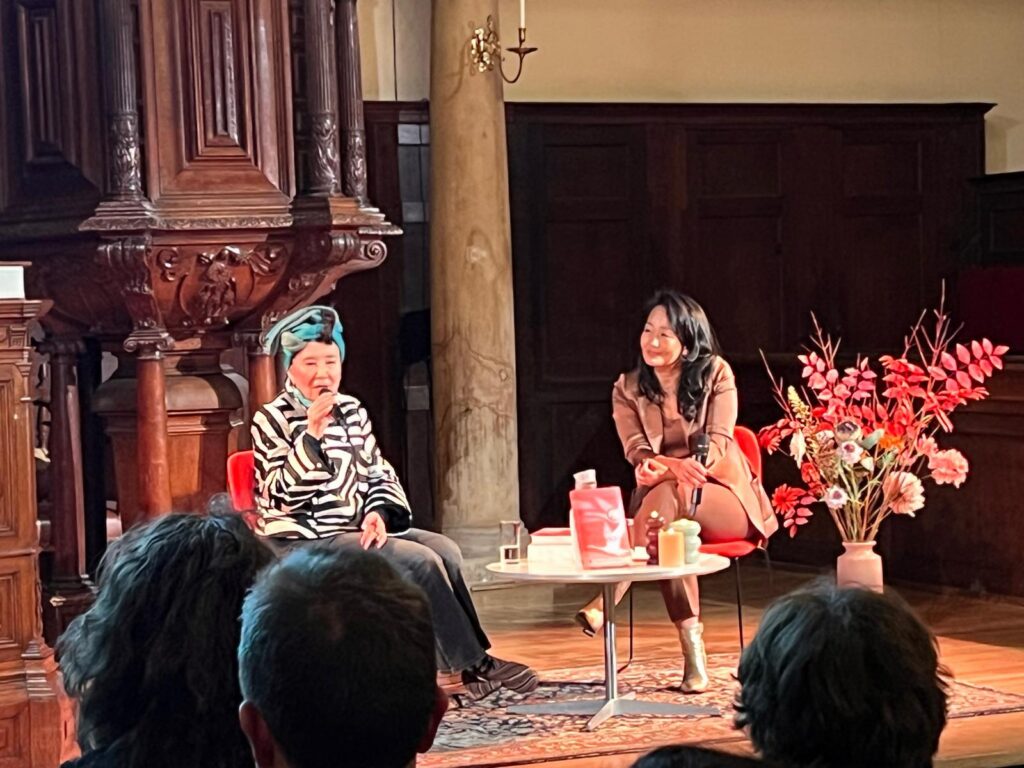
But on a Thursday evening in February, fans in the Netherlands were surprised: Jung Chang was interviewed in the Old Lutheran Church on the Spui in Amsterdam. Aged, but with a clear and powerful story.
The whole room felt her drive to tell important, true stories that should not be in the spotlight in China.
Fly, Wild Swans has the subtitle My mother, China and I. It reads like an ode to her mother. It was she who always encouraged her to write from China, even when things got difficult and she herself could be in danger. She always encouraged her daughter, said: “Don’t become Nora”, after the protagonist of Ibsen’s play The Doll’s House, who, as a woman, had no chance to develop herself as an individual.
Jung Chang seized those opportunities, and how, from the moment she ended up in the United Kingdom in 1978 and has stayed there ever since.
Together with her husband Jon Halliday, she wrote numerous books (all banned in China), including biographies of Mao Zedong and the last empress, Cixi. All on the basis of interviews and extensive archival research, which was not always easy, especially in China, and required a lot of perseverance and courage.
“You are a very courageous person,” remarked interviewer Mischa Blok in the Lutheran Church. Jung Chang replied that it was her parents who were brave. She also described this in Fly, Wild Swans . Her father, for example, who became a convinced communist at a young age, but later, during the great famines in the late 1950s, sent a letter to party chairman Mao to protest. The provincial governor who had to forward the letter convinced him not to do so, also in view of the possible damage to his young family. Father gave in, but his conscience continued to gnaw. And then, during violent popular trials in the Cultural Revolution, he refused to bow, which brought him hard blows. Eventually, he would physically succumb and die. In the official books, her father is still mentioned as an ‘anti-Mao criminal’ because of that letter – although not sent – and he has not been rehabilitated so far.
Her mother had also become a communist at a young age, partly for a personal reason: her grandmother managed to flee as a concubine on her bound ‘lotus feet’, and thus give herself and her young daughter a life of her own. One of the spearheads of the early communists was to abolish concubinage – and the binding of women’s feet. In practice, according to Jung Chang, the communist ‘liberators’ also looked down on her grandmother, as a former concubine. However, canceling membership of the Party was never an option, that was equivalent to desertion and was severely punished.
In 1978, Jung Chang was able to go to the United Kingdom as a student. Into freedom.
When did you discover that you were free of spirit? asked Mischa Blok. Jung Chang: “We never thought in those terms. Freedom was not a criterion. We were conditioned to follow Mao’s orders. He was part of our existence, our god. He was unmentionable“. That she has now started to think differently after years becomes apparent at the end of the evening, when she remarks: “I think it’s horrible that Mao belongs to China”.
Jung Chang feels at home in the UK, she answers the last question from the audience. “But I don’t really like the concept of ‘belonging somewhere’. I decorated my house in Chinese style”. She also proudly points to her turquoise silk headdress, “Silk from my native village of Sichuan, one of the best varieties in China”.
Jung Chang: Fly, wild swans. My mother, China and me , and several other works by Jung Chang have been published by De Boekerij.


