
by Xixi Wang
In the autumn of 2026, VNC organized a group trip to China centred on the theme of Healthy Living in China, exploring topics such as exercise, nutrition, and preventive healthcare. Following this journey, Xixi Wang wrote a three-part series on healthcare in China for this website (see: https://www.vnc-china.nl/en/uncle-chens-cough-and-the-transformation-of-chinas-healthcare-system/ and https://www.vnc-china.nl/en/cocktail-with-a-pulse-diagnosis-chinas-ancient-wellness-reinvented/)
This third and final article highlights how AI and apps are transforming the entire healthcare ecosystem.
China’s Latest Revolution
China is home to 1.41 billion people. In 2025 alone, China recorded roughly 10.58 billion outpatient visits and 300 million hospital discharges (1). That is nearly 29 million patient encounters every single day. For sustainability, everyday efficiency, and long-term development of the nation’s healthcare system, digital transformation is a necessity. For a system of this magnitude running only on paper files and physical queues, it is impossible. The journey to building a digital system for the entire population, of course, took serious commitment.
The first article followed Uncle Chen, a patient’s experience through the physical realities of visiting a distant urban hospital, before China’s healthcare reform. This third article revisits Uncle Chen’s world and shows how the landscape has further changed in the past 3-5 years due to digital transformation. It examines two sides of this revolution: how online platforms streamline physical hospital visits, and how AI assistants and virtual clinics are bringing professional healthcare directly into patients’ homes.
Digital Transformation in Healthcare
Uncle Chen’s journey began with a cough. It ended at a provincial hospital hundreds of kilometres from home. He went because his local clinic lacked a specialist. He did not trust it. What he experienced upon arrival revealed the shape of the healthcare system. There was an hours-long queue. There was the difficulty of knowing which department and doctor to see. And there was the obligation to keep and carry his own medical records from one hospital to another, because medical institutions did not share cloud-based data.
All of this reflected a system that asked patients to absorb the cost of reaching them. That cost came in three forms: time, information, and repetition. Digital reforms have reduced each barrier, piece by piece.
From a memory of queuing to a slot on a screen
When Uncle Chen queued at the provincial hospital, he was one of hundreds of millions doing the same. Queuing was not an occasional inconvenience but a structural time burden for all. One of the solutions to that was an online booking system.
In September 2025 National Health Commission Director Haichao Lei reported that 87% of public hospitals at secondary level and above had introduced appointment-based outpatient services, with corresponding reductions in waiting times (2).
Patients can typically make appointments through two digital channels.
One is the provincial unified booking platform. Beijing is a useful example. After nearly 300 secondary and tertiary hospitals in Beijing were connected to the unified Jingtong platform (京通), official statistics showed that the platform handled nearly 25 million registrations in 2025, which accounts for about 40% of online appointment registrations at the capital’s secondary and tertiary hospitals (3).
The other is the hospital’s own mobile channel. Shanghai’s Ruijin Hospital, one of the country’s largest tertiary centers, runs its appointment system through its official WeChat account and Alipay mini-program, both updated in sync. Ruijin operates a full-appointment model: essentially all slots are released online in advance, with only a small number of same-day slots remaining if an appointment period has not been filled. The old fear of being turned away has largely dissolved.
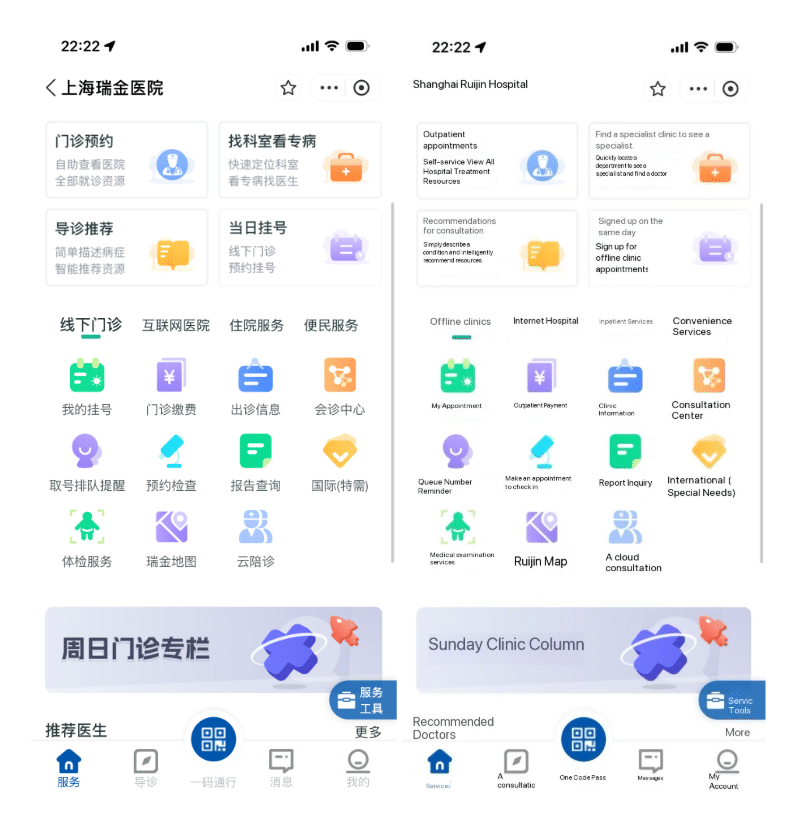
However, for many elderly and patients with special needs, booking online can be challenging, not merely inconvenient but exclusionary, because the digital channel assumes a smartphone, an account, and the literacy to navigate a digital interface. The National Health Commission has responded to this matter by requiring hospitals to keep staffed windows and telephone lines, reserve on-site slots for older patients, and allow family members or community doctors to book on their behalf.
During a recent visit to a hospital in Shanghai, I experienced this dual reality myself. I booked a slot on my phone a week prior, checked in at a lobby kiosk 10 minutes before my appointment, and saw the doctor within 20 minutes. After paying at another kiosk and waiting briefly at the pharmacy, I left with my prescription. By contrast, I saw elderly patients struggle with the paperless medical experience. They stood uncertainly at self-service kiosks, asked staff to repeat instructions, or handed their phones to a volunteer who navigated the interface for them. For sure, accessibility remains an ongoing issue.
From whoever is on duty to a named doctor on a screen
Another big advantage of booking online is perhaps the possibility to choose a doctor yourself. Previously, Uncle Chen traveled to that distant hospital without knowing the name of a doctor. He was assigned to the doctor who happened to be on duty in the department in question, without knowing anything about that doctor.
The booking screen changes the level at which patients make choices. Today’s interface shows the name of the doctor, the job title, the department and often a specific specialty; For example, thyroid surgery instead of simply general surgery. Patients can compare names to doctor and hospital pages, academic titles, and the growing ecosystem of online assessments and patient forums. All this information is available to make an informed decision.
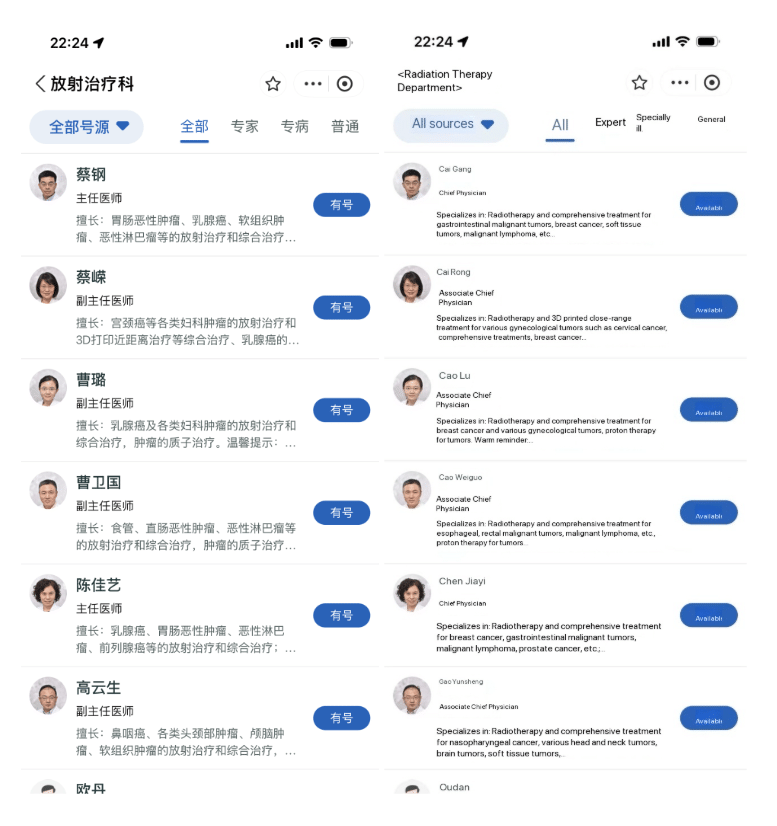
In the ‘analogue era’, whether a doctor was competent could be known only to a small circle of people connected to a given hospital or to particular patient groups. The ability to verify, identify, and cross-check a doctor is therefore a modest step toward equity in access to medical information, and more broadly, toward fairness in health care.
From repetition to broad recognition; uniformity in healthcare
In 2022, China established a unified national platform for medical insurance information. This digital infrastructure enables cross-provincial, cross-level, and cross-departmental data sharing and service integration for medical insurance. As of November 2025, this platform covers 1.33 billion insured people, 1.14 million designated hospitals and pharmacies, supporting approximately 3 trillion RMB in annual settlements across 10 billion transactions (4).
However, better insurance could not fix a second cost. Moving between hospitals meant starting over. A patient who had a CT scan at a county hospital on Monday could be asked to repeat it at a city hospital on Thursday, meaning the same scan, the same radiation, the same fee, the same hours of waiting, simply because the second hospital had no reliable way to read or trust the first hospital’s result. From the patient’s side, this did not feel like continuity of care. It felt like being asked to prove, at every new door, that they were ill.
In 2024, the national government (5) issued guidance, setting a deadline and a numerical target: by the end of 2025, mutual recognition within each prefecture-level city was to exceed 200 examination and testing items, with a further goal of over 300 items within each province by 2027. By the end of 2025, that first target had largely been met nationwide (6). Where a prior result is recognized, those above-mentioned costs for the patient fall away.
In summary, digital transformation addresses the three costs to the patient. The queue was a cost in time; the anonymous doctor in information; and the repeated scan in duplication – both for the patient and the medical system. For a patient, these are huge differences, and they significantly reduce the friction of moving through a system that is still largely structurally uneven.
The Virtual Clinic and the Last Mile
Now, imagine Uncle Chen recovering well and simply needs a repeat prescription. In the old system, that meant another trip: book a slot, travel, queue, see a doctor for five minutes, collect a paper prescription, queue at the pharmacy. Today, businesses are offering services that meet those needs.
Medicines at the door: the Meituan and Ele.me apps
Meituan (美团) and Ele.me (饿了吗) started as Chinese food delivery platforms, just like Thuisbezorgd or Uber Eats. They now move pharmaceuticals as well through their delivery networks. Meituan alone works with 160,000 medical institutions and 250,000 pharmacies (7). Medicine ordered through the app arrives in 22 minutes on average. For urgent cases, a one-to-one express delivery service shortens that further. Meanwhile, leveraging a nationwide network of 15,000 24-hour pharmacies – complemented by 24/7 online medical consultations – the platform ensures rapid responses to urgent needs, such as a fever in the middle of the night or an allergic reaction while travelling.
The critical detail is that these delivery apps have wired insurance payments into the checkout flow, deducting it at the point of sale, not reimbursing the cost afterward. For a patient with a settled prescription, this is the shortest path between ‘I need more of this’ and ‘it is on my table’.
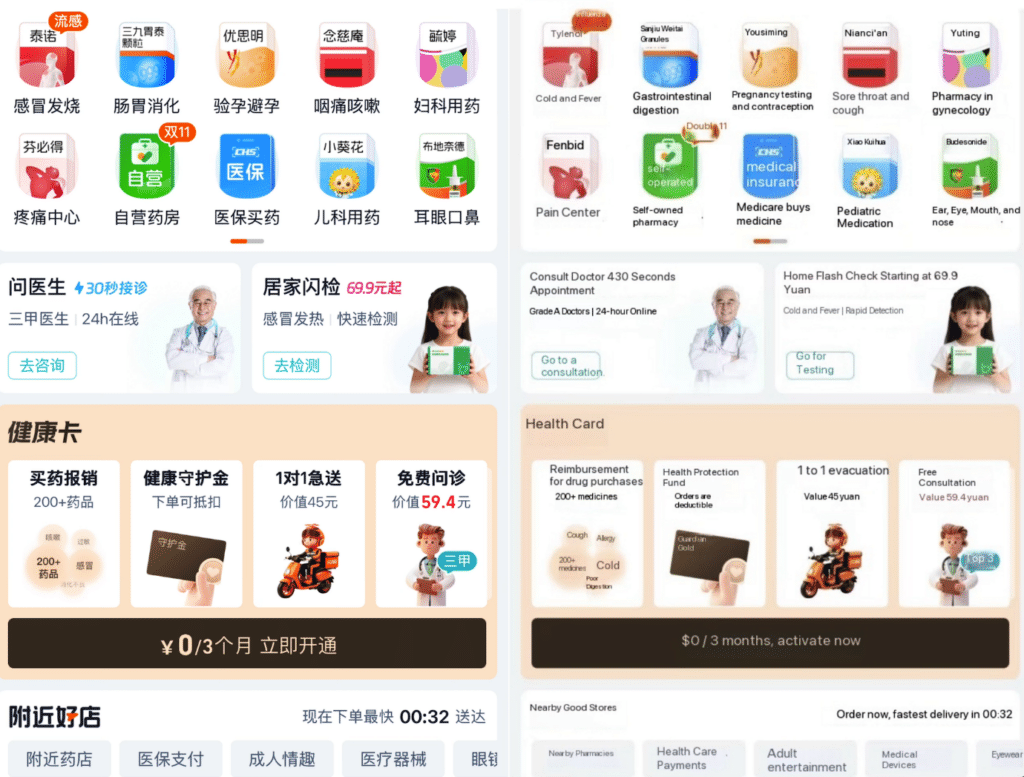
But isn’t it too easy to get medicines this way? How is abuse prevented? Since May 2026, the National Medical Products Administration has required real prescriptions, real-name sales, and pharmacist review, explicitly prohibiting AI from substituting for the pharmacist’s prescription review (8). For Uncle Chen, this means the app cannot simply refill his prescription indefinitely on its own say-so.
The AI gate: the Ant Afu app
Now imagine a different version of Uncle Chen’s situation. His symptoms are almost the same as before, but something has shifted: a new ache and a different pattern. He does not know whether this is a variation of his existing condition, a side effect of the medication, or something new. Back in the day, the only way to find out was to book another appointment and travel again. Now, an AI health assistant can jump in.
Ant Afu (蚂蚁阿福) is an AI health assistant that Ant Group first launched as a standalone app in June 2025, following an earlier Alipay mini-program trial in 2024.
Ant Afu, trained on clinical records, exists for exactly these kinds of moments, before or in between hospital visits. Uncle Chen can upload his earlier CT scans, his medication list, and his doctor’s notes. The app reads the imaging, translates the clinical vocabulary into everyday language, and compares the new ache against his records. It can flag that the lab value has shifted in a way that sometimes occurs with his medication, or that the new pattern does not match what was seen before. As Uncle Chen struggles with typing on the screen, he can speak to it in his own local dialect and use the elder mode built for voice-first interaction.
September 2026, Afu unveiled the latest data: the app’s user base has reached 150 million, with nearly 20 million health consultations taking place daily (9). Crucially, 55% of its users come from tier-three cities and below, the demographic which the current public healthcare system underserves. The app’s basic health Q&A is entirely free to use, with the company stating that future commercial design will centre on affordability rather than charging for the consultation itself. For Uncle Chen, the AI does not replace his doctor – it simply saves him a trip just to find out whether a visit is necessary.
The hospital in the living room: the JD Health app
Now, let’s imagine Ant Afu tells Uncle Chen that the new ache may warrant a closer look, and that a hospital visit may be needed. Before booking a public-hospital appointment, he can now cross-check with an online doctor first. For example, he can open JD Health (京东健康) on his phone, and through it, he can obtain 24-hour online consultation within an average connection time of 30 seconds. Here is what’s special about JD Health’s service.
Let’s say, to be sure the medication is working, the doctor orders a blood test. A licensed nurse from JD Nurse to Home arrives at his door to collect the sample. The sample is sent directly to a partnering hospital laboratory, and the official diagnostic report returns to Uncle Chen’s phone within hours. Another doctor reviews the results, adjusts his prescription, and sends it to the pharmacy. By evening, the medicine is delivered to his home. The whole experience is paperless: patients pay digitally, and records are stored in their JD personal account.
JD Health is the healthcare arm of e-commerce giant JD.com. In 2025, JD Health aggressively expanded its at-home medical network, aiming to offer a closed-loop service where users can see a doctor online, get tested at home, have medicine delivered, and receive nursing care at home. The growth of this network has been striking. Its rapid home testing service expanded to 27 cities, offering over 160 types of tests (10). The demand is real – during the 2025 flu season, rapid-test orders surged by 238% year-on-year.
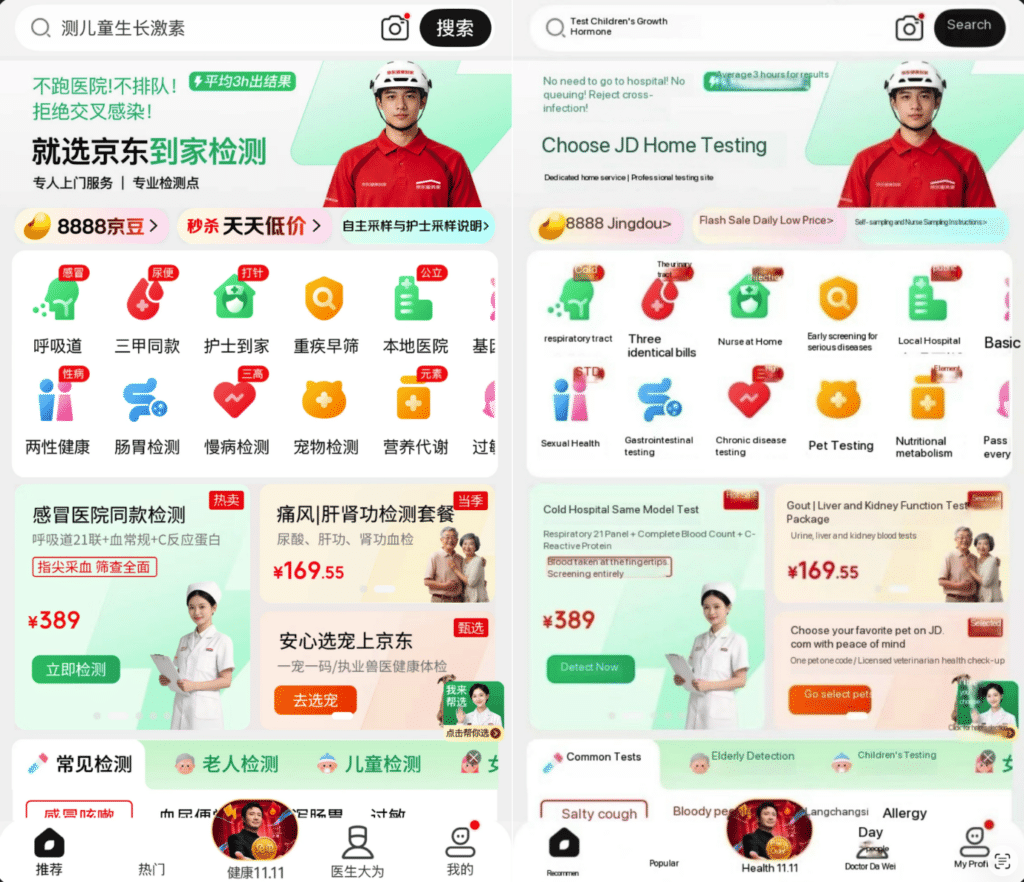
If he needs ongoing care, the platform also offers Nurse Home Visit Service. By the end of 2025, more than 21,000 nurses had registered on the platform, and its home nursing service covered 47 cities. That said, JD Health’s services have not reached every corner of China. For Uncle Chen, who is not city-dwelling, receiving test results and medication within the same day is likely an overly optimistic prediction.
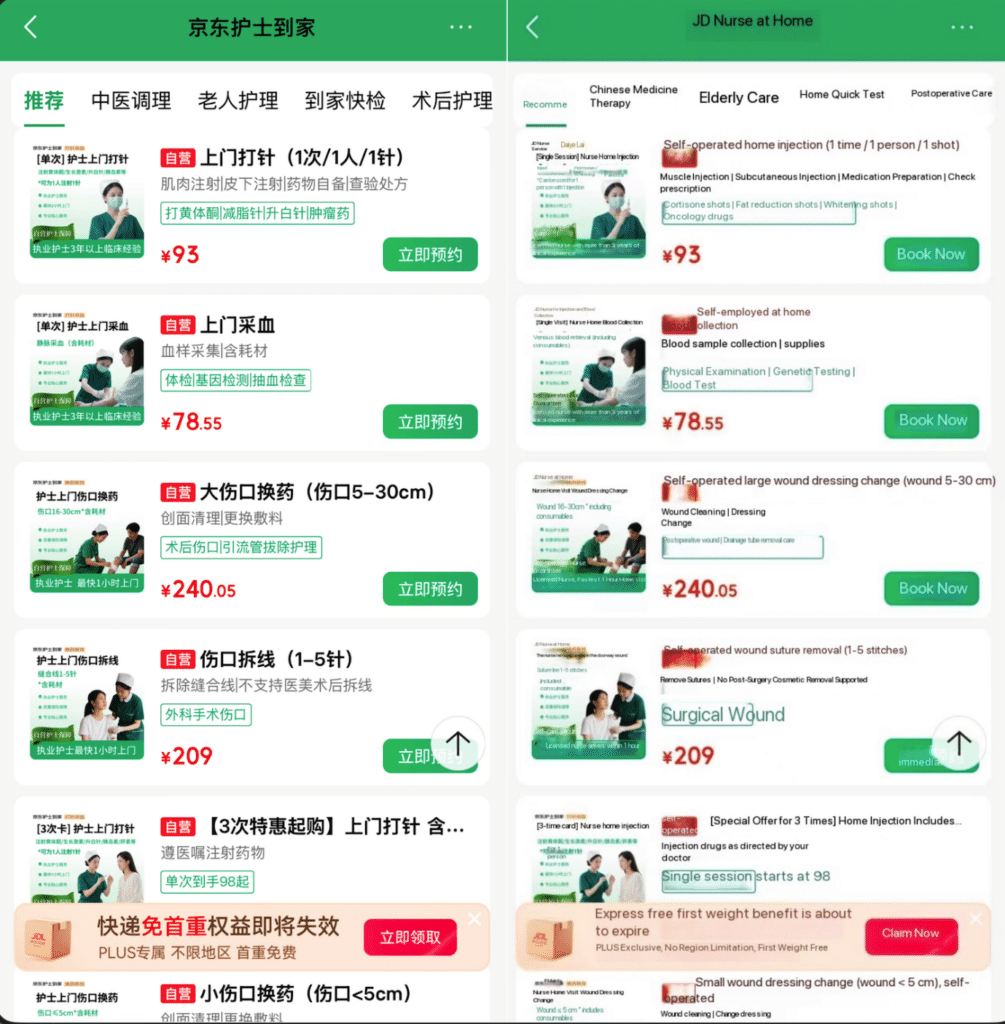
JD Health provides a faster way to receive medical care. Beyond that, it also leads to the disassembly of the hospital itself. The traditional hospital operates as a single physical location where consultation, testing, and pharmacy are bound to the same building. Here, those components are pulled apart and delivered to the patient’s living room in a continuous sequence. For patients in need of special help, this is literally life-saving.
Final Notes
The digital transformation of China’s healthcare system spans innovation of both process and structure. Process improvements smooth the path for the patient who still travels. They show how digital tools eased the friction of the physical hospital – the queue became a scheduled slot on a screen, the anonymous doctor became a named specialist chosen from a phone, and the repeated scan became a result shared across a national network. Structural innovations support the patient who no longer travels at all. Here, the hospital’s clinical infrastructure is unbundled and delivered to the doorstep: an AI assistant turns clinical jargon into plain language, a nurse brings the medical service to the home, and a delivery rider brings the medicine before the day is done.
These digital networks are reaching populations that are largely underserved by major health facilities, staff, and resources. Yet this is not a story of a frictionless utopia. For older and differently abled patients, the screen can still be a barrier rather than a bridge. The infrastructure is extending outward, but the edges of the network remain uneven.
Still, looking ahead, the trajectory is profoundly hopeful. The foundation has been laid. Digital infrastructure continues to reach deeper into the countryside and into the smallest details of the care cycle, while AI health assistants become ever-more capable partners to human clinicians. The goal is a healthcare system that is ever more accessible, personalized, and universal.
Xixi Wang is a Dutch university alumna (BA Social Justice & Philosophy, CA/NO; Research MA Gender Studies, NL) from China. As the Founder of CUE (since 2020), she sees supporting people through key life transitions as her life’s mission. She is passionate about bridging knowledge across borders and advancing health equity, with previous research-informed articles reaching over 20 million readers in China and the U.S. Check out CUE’s website: https://cuelifetransition.com/

References
1. National Bureau of Statistics of China. (2026, March 2). 中华人民共和 国2025年国民经济和社会发展统计公报 [Statistical communiqué of the People’s Republic of China on the 2025 national economic and social development]. Xinhua News Agency. http://www.hnzy.gov.cn/content/646047/94/15731236.html
2. CCTV News. (2025, September 11). 国家卫健委:87%的二级以上公立医院开展预约诊疗服务 [National Health Commission: 87% of secondary and above public hospitals offer appointment-based medical services]. 央视新闻 [CCTV News]. https://content-static.cctvnews.cctv.com/snow-book/index.html?item_id=7603063348326631191&channelId=1119&toc_style_id=feeds_default&track_id=F81840C1-3982-476D-B53C-382797201631_779268291838&share_to=wechat
3. Btime. (2026, February 9). 北京全部近300家医院,有了统一挂号平台!放号时间一致 [All nearly 300 hospitals in Beijing now have a unified booking platform! Consistent slot release times]. 北京时间 [Btime]. https://item.btime.com/424npq0odte8avb6osf75tlil9k
4. Zhang, K. (2025, December 26). 国家医保局党组书记、局长章轲:着力构建智慧医保服务新格局 助力完善多层次医疗保障体系 [Secretary and Director of the National Healthcare Security Administration Zhang Ke: Striving to build a new pattern of smart medical insurance services to help improve the multi-tiered medical security system]. 《中国网信》杂志 [China Cyberspace Journal]. https://www.nhsa.gov.cn/art/2025/12/26/art_14_19158.html
5. National Health Commission, National Development and Reform Commission, Ministry of Finance, National Healthcare Security Administration, National Administration of Traditional Chinese Medicine, National Disease Control and Prevention Administration, & Health Bureau of the Central Military Commission’s Logistics Support Department. (2024). 关于进一步推进医疗机构检查检验结果互认的指导意见 [Guiding opinions on further promoting mutual recognition of examination and testing results across medical institutions] (国卫医政发〔2024〕37号). 国务院公报 [State Council Gazette]. https://www.gov.cn/gongbao/2025/issue_11846/202502/content_7002779.html
6. CCTV News. (2025b, December 26). 国家卫健委:目前所有省份实现医疗机构间检查检验结果互认项目超200项 [National Health Commission: Currently, all provinces have achieved mutual recognition of over 200 examination and testing items among medical institutions]. 中工网 [China Workers’ Network]. https://www.workercn.cn/c/2025-12-26/8694153.shtml
7. Xinhua. (2026, August 7). 美团王莆中:将AI融入家庭健康,助力建设”15分钟医疗圈” [Meituan’s Wang Puzhong: Integrating AI into family health to help build a “15-minute medical circle”]. 新华网 [Xinhua]. https://www.xinhuanet.com/tech/20260807/24138778318441a7bd979b95e66bf391/c.html
8. CCTV News. (2026, May 25). 最新明确:网售处方药必须凭真实处方、实名制销售,严禁AI替代审方 [Latest clarification: Online sales of prescription drugs must be based on real prescriptions and real-name sales; AI is strictly prohibited from substituting for prescription review]. 光明网 [Guangming Online]. https://m.gmw.cn/2026-05/25/content_1304470488.htm
9. Ant Group. (2025, December 15). 蚂蚁集团AQ升级为”蚂蚁阿福”:发力”健康+”战略,App月活超3000万 [Ant Group’s AQ upgraded to “Ant Afu”: Focusing on the “Health+” strategy, App MAU exceeds 30 million]. 蚂蚁集团 [Ant Group]. https://www.antgroup.com/news-media/press-releases/1765785600000
10. Economic Information Daily. (2026, March 11). 京东健康2025年业绩超预期 京东到家快检全年订单同比增超八成 [JD Health’s 2025 performance exceeds expectations; JD at-home rapid tests annual orders surge over 80% year-on-year]. 经济参考网 [Economic Information Daily]. http://jjckb.xinhuanet.com/20260311/930d0f852850433a8721482a477ca017/c.html


