
In conversation with John de Weerdt
by Marilou den Outer
Those who practice Zen in the Netherlands often do so in Japanese style. This is how John de Weerdt came into contact with Buddhism years ago. Driven by curiosity and inquisitiveness, he developed a predilection for source texts. His search inevitably also took him to China, where Zen (chán, 禅) has undergone an important development. Only then did this movement reach Japan. To discover how Zen is practiced in China today, he decided to travel to Buddhist places in China with his wife Annie Zheng Yi. Eventually, this resulted in a Zen group trip last December with fifteen Zen practitioners.
An intriguing winter journey through remote areas. With beautiful encounters in monasteries and joy at the sight of the rice pestle of the sixth Zen patriarch Huineng (7th century AD). “It was really there!”.
Versatile person
We speak to John about the journey and the origin of Zen in IJsselstein, where he teaches at Ming Zen Center. He also teaches in Utrecht at Zentrum. His own teachers are Nico Tydeman and Willem Scheepers, who ordained him as a monk and gave him full dharma transmission, which means that he can call himself a Zen master. Outside the Zen world, people may know John as an entrepreneur, and as a co-founder of the business network Guanxi.nu, the predecessor of the VNC China Café.
Devotion vs Meditation
Zen Buddhism, chán, is not the largest movement in China, he says. That is the Pure Land, in which recitation and devotion are central. In Chinese temples, this movement can often be recognized by people who light incense and ask for a good exam result or a new courtship. Chán practitioners, on the other hand, mainly focus on meditation to discover their own buddha-nature and gain insight. Chán is a corruption of the Sanskrit dhyana, which means ‘meditation’.
The origin of chán
John: “The story goes that Bodhidharma was the one who introduced this dhyana school in the fifth century. He is considered the first Zen patriarch in China. Dhyana – meditation – touched on mysticism, just like Taoism, which was already known in China. That made for an easy introduction; They found each other in it and the rituals fitted in nicely. A ‘chemical reaction’ arose resulting in chán, or Chinese Buddhism, which later blew over to Japan and became ‘zen’ there.”
In the course of those early years, there have been six patriarchs who passed on the tradition. Initially, these were wandering loners, but later monastic communities arose. Later in the Song Dynasty, chán became the most dominant form of Buddhism in China. Beautiful stories have emerged, which do not always have historical grounds, but do appeal to the imagination.
Strong stories
For example, about Huike, a scribe who had a profound knowledge of Buddhism, but could not find liberation in that knowledge. So he went looking – like many others at the time – and ended up with Bodhidharma. However, he was not convinced of him and left him in the snow in the cold. To show his determination, Huike would then have cut off his own left arm. This led to acceptance and he eventually became the second Zen patriarch. John: “On our trip, we visited that place in Hubei, on the border with Anhui. Also in the winter, to experience what that must have been like for all those practitioners, that was very special.”
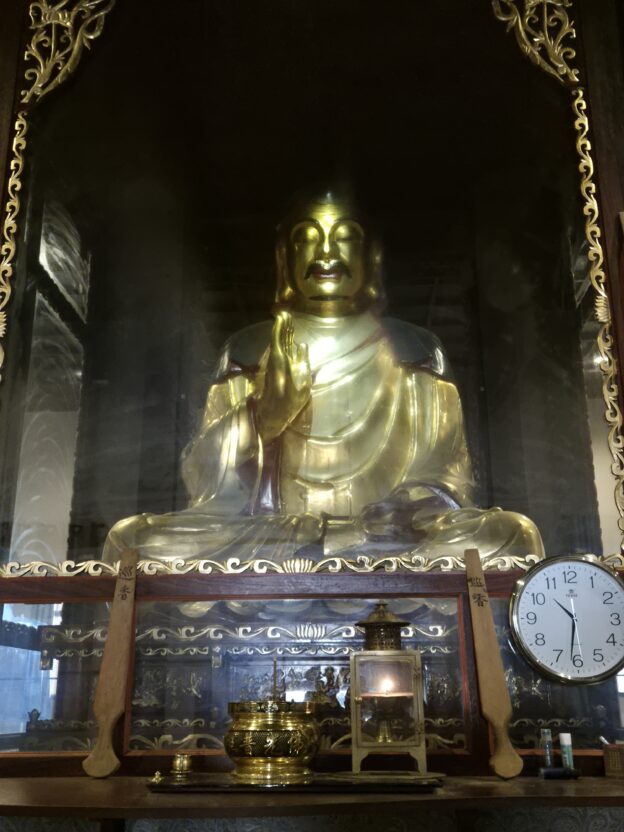
Tangible past; poem and rice pestle
Jianzhi Sengcan Dayi (僧璨) (†606) – the third chán patriarch – wrote the poem ‘Trust in the Mind’, the first scripture in which the synthesis of Buddhism and Taoism can be seen. During the visit to the monastery of this patriarch, the abbot of the monastery gave this text as a gift to Zen master John.
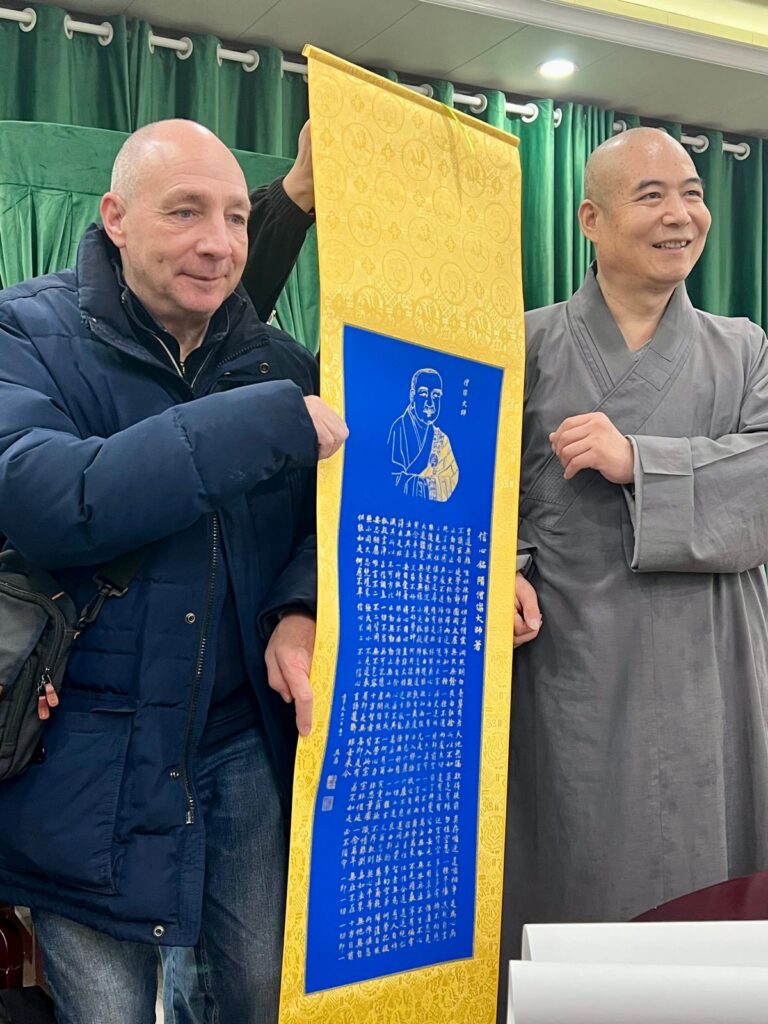
The first lines read translated:
“The way is not difficult,
for those who have no likes or dislikes.
If you want to see it with your own eyes,
you can’t afford to think for or against.”
There was also a tangible past at the monastery where the sixth patriarch Dajian Huineng (7th century) received transmission. According to the story, he was an illiterate collector of undergrowth, who immediately ‘woke up’ after hearing a recitation of the Diamond Sutra. He was admitted to the monastery as a simple rice pestle. When the incumbent patriarch Hongren launched a poetry contest to find a suitable successor, Huineng submitted his poem orally – and was elected. As the sixth patriarch, he is still seen as the founder of the school of ‘sudden enlightenment’ within the chan tradition. This monastery was also on the route. John: “Seeing that rice masher was one of my goals during this trip. And yes, wonderful to see that – the stone part – was still there!”

The trip visited a total of five Zen monasteries in fourteen days. John: “We started in Shanghai, where we could get a taste of the super modern life in China. Then we went with the high-speed train into the province of Anhui. We meditated with the monks in monasteries, and also spent the night there once. We were very warmly welcomed everywhere. The participants were very enthusiastic; These are the roots of Zen!”.

With chán more qi
As far as the Zen practice is concerned, the group has noticed that it is different from the Japanese one, or as we do it in the Japanese way in the Netherlands. In China it is looser and freer, but very serious. A striking difference is, among other things, the way of walking meditation as a variation from sitting meditation. Where in the Japanese Zen tradition this happens first in a slow and then in a fast pace, in China it all went very quickly, often with strong movements of arms and legs. John: “That was driven by the cold, of course, but also to evoke qi – vital energy. We noticed that we were much more physical afterwards. I have also taken over some of that myself, back in the Netherlands: I used to cycle from home to the meditation room, now I walk. As a result, I arrive much more physically. Isn’t that great!”
To be continued
Because this Zen trip went so well, John, as a spiritual guide and Annie, as a tour guide (both in the accompanying photo) are organizing another trip for Zen practitioners in December 2026. With a slightly modified route and extra nights in a monastery.
More information and photos about the trip described here and the trip that is planned on the website https://www.zen-training.nl/zen-reis-china/
More information about Chán Buddhism in China, see Wikipedia


