by Lotte Bakker
On Monday 7 September, I had the opportunity to attend an event of VNC (Netherlands-China Association) where two guest speakers, sexologist Sanderijn van der Doef and entrepreneur Xixi Wang, spoke about the changes and differences in love, sexuality and intimacy between the Netherlands and China.
Van der Doef kicked off the evening by recounting her first trip to China in 1982, the year the country opened its borders to individual travelers. Stince 2009, she returned annually on behalf of the Dutch expertise center Rutgers to provide training in sex education. At the time, the Netherlands was viewed internationally as a ‘pioneer’ in this field, thanks to its early and structured sex education in schools. Back then, China was open to Western knowledge and methods, and Van der Doef witnessed Chinese teachers being introduced to interactive, group-oriented educational formats for the first time.
China now relies on its own expertise
However, this picture has shifted sharply in recent years. Since 2023, Van der Doef has noticed that the ‘open-arms politics’, which previously welcomed Western know-how, has given way to a China that no longer needs this input and relies on its own expertise. She cited as an example a national conference on sex education and sexuality where, unlike previous editions, the last one she attended in 2023 featured no Western speaker at all. At the same time, sex education has become mandatory in schools since 2021, although the content based on Western methods is strongly adapted to local, conservative standards. Van der Doef’s central message was that knowledge alone is not enough. Talking to young people about sexuality in a good way is a skill, and not a matter of course.
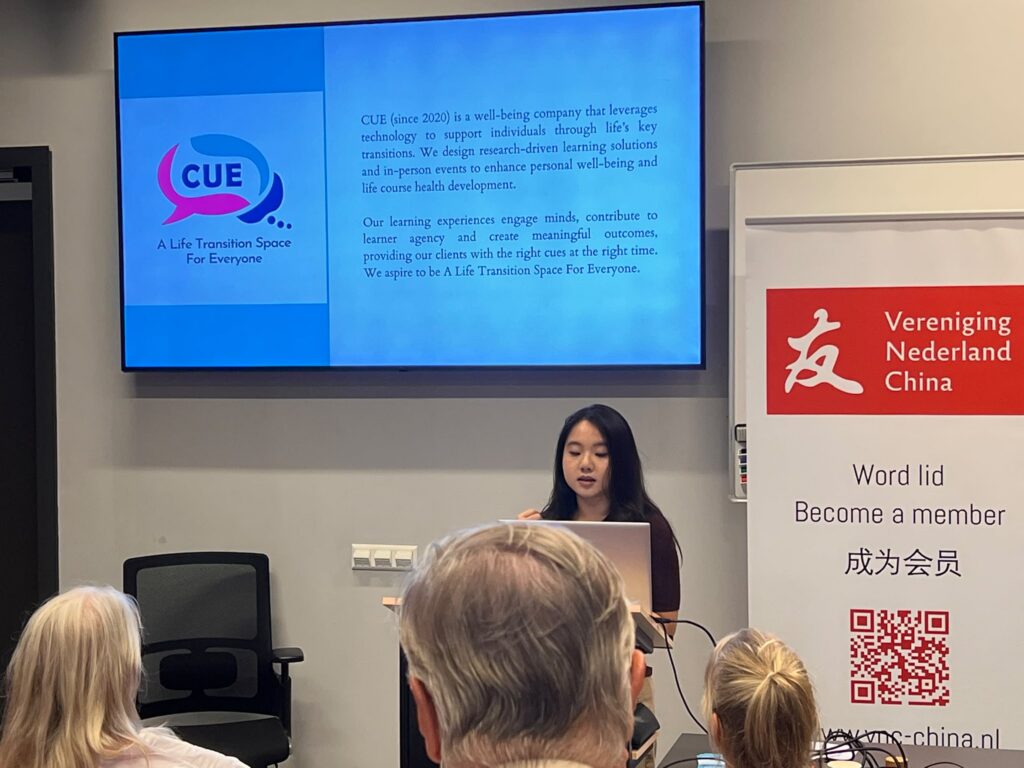
Xixi Wang, born in Guangzhou and currently active between Shanghai and Utrecht, took over the floor from Van der Doef. While Van der Doef had already touched upon he booming nature of female sexuality in China during her presentation, Wang built on this and approached the topic from a sharper, critical framework.
Liberation – free from what?
Her presentation focused on the meaning of ‘sexual liberation’. Because what does this actually mean? Free of what? Freedom to do what? And above all: who gets that freedom, and who pays the price for it? Using data on the Chinese sex market, she illustrated a rapidly changing landscape. While thirty years ago Beijing’s first sex shop had to wait weeks for its first customer, the sector is now thriving online and increasingly targeting female pleasure.
At the same time, the percentage of sexually active young people under 25 is declining sharply. One explanation Wang offered is that young people rely more and more on their online worlds and consequently meet fewer new people in real life. Furthermore, she noted that women are claiming greater autonomy over their sex lives, reducing their desire to meet men.
Virtual ‘dream partner’
A striking trend in this light is the rise of AI dating apps that allow users to create a virtual “dream partner.” This is likely to reduce the need for a real partner as well. Moreover, an uncomfortable truth lies behind the abortion statistics: in 2023, China recorded 9.7 million abortions compared to 9.02 million births. So while the sex market thrives and freedom is celebrated, Wang argued that young women are primarily the ones footing the bill—not only physically, but also in the form of social shame and stigma.
Towards the end of the evening, Wang raised a question that truly struck at the core of what the event was all about: who decides whether something is liberation, or rather backwardness? It turned out to be a question without a simple answer, both in the Netherlands and in China. What I took home with me was plenty of food for thought regarding freedom, intimacy, and who pays the price for it.