
by Astrid Bouwman
On Saturday 20 August, photographer and curator Ruben Lundgren took us on a journey through his own exceptional solo exhibition Flowers in the Mirror at the Hague Museum of Photography. Although this was the final chance to see the exhibition, we are happy to look back at this event organized by VNC. Alongside his body of work, published in 23 books, his perspective on life in China is equally interesting.

Who is Ruben Lundgren
At the age of twenty-one, he left for China as a photography student, where mastering the language and culture coincided with his search for an overtly queer identity. That period of study ultimately extended into a twenty-year stay. China proved to be the perfect backdrop for his fascination with the tension between identity, image and illusion – themes that he invariably pairs with a wink and a healthy dose of humor.
At Working as a Photographer
Initially, Lundgren in a purely conceptual manner, collaborating with Thijs Groot Wassink under the name WassinkLundgren. They came up with a subject, made a plan and went out with their cameras. Later in his career, his focus shifted to spontaneous interaction with his surroundings, and he began experimenting with the changing nature of the medium of photography.
- Empty Bottles (2007)
One of his earliest and best-known series, created in collaboration with Thijs groot Wassink. For this project, they photographed the exact moment when people picked up plastic bottles – placed by themselves – on the streets of Beijing. This yielded in a diverse procession of people; from well-dressed ladies cleaning up litter to individuals who depended on the proceeds to survive. Sometimes they had a bite within five minutes, sometimes they had to wait five hours.
- Lu Xiaoben (2010)
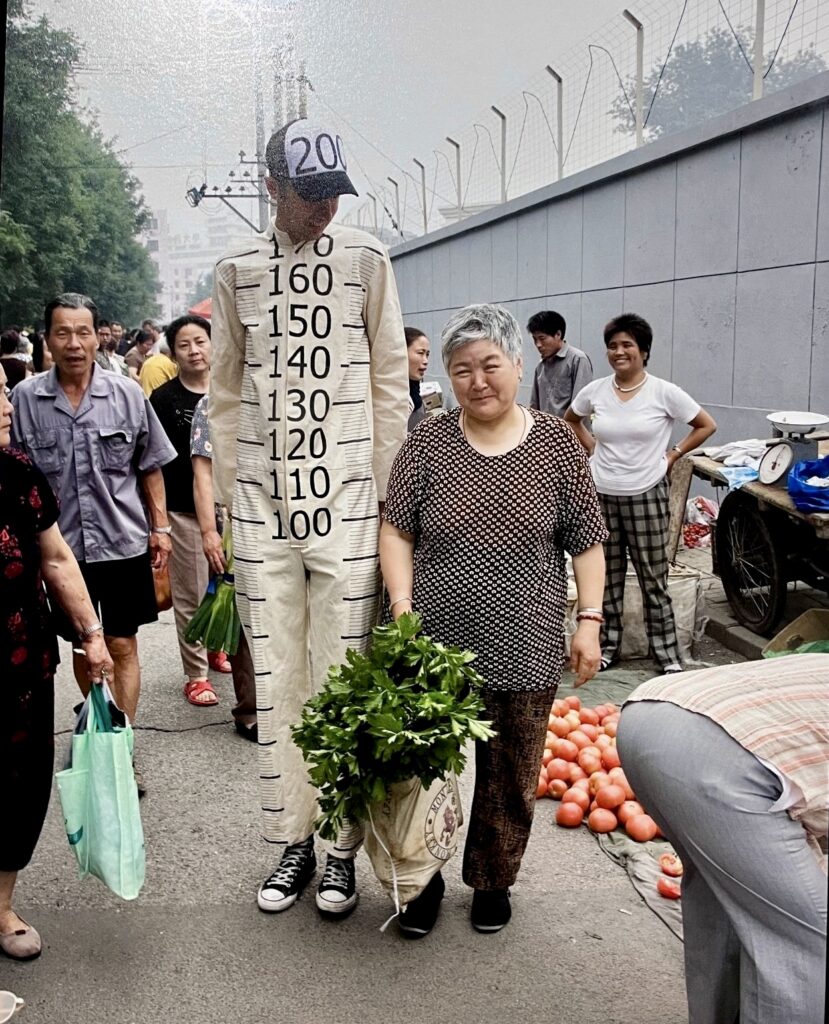
Because of his height of two meters, it was impossible for Lundgren to go unnoticed in China. Therefore, under his Chinese name, he devised the project ‘I am famous’ precisely to make use of his ‘stardom’. He had a suit made with his height printed in centimeters on it and went out onto the streets. This resulted in wonderful interactions and images. When the project was awarded an prize, Lundgren considered it the natural endpoint for the series.
- Beijing Beijing (2010)
For this series, the duo WassinkLundgren set out together. They simultaneously photographed the same individuals, but each from their own distinct position. In doing so, they provided a direct critique – and a parody – of Henri Cartier-Bresson’s mythical concept of the ‘decisive moment’. Instead of waiting for that single, ultimate image through one individual eye, the photographers demonstrated that reality consists of multiple simultaneous angles. After all, is the person in front of the lens a shabby couple in a shantytown, or a hipurban couple?

- Aaaaaaaao (2011)
How do you capture the visual culture of social media, live-streams, and the absurdist, flashy aesthetic of contemporary China? Lundgren created a series centered around the Chinese hit songTan Te (忐忑).At the time, this song sparked a flood of videos in which people went crazy in front of their laptop or smartphone while singing along. The streams were viewed by millions; Lundgren used the screenshot ffunction on his laptop to capture them. The result displays not only a single moment from such a video and the performer’s enthusiasm, but also the intimate setting in which individuals present themselves online.

Press Photographer
Lundgren also worked as a press photographer for deVolkskrant, NRCandThe Guardian, in that capacity traveling to extraordinary locations in China. In this work, too, he seeks out humour and contradictions. What does it still mean to be a press photographer when everyone carries a camera? Consider the photograph featuring a man with a selfie-stick squared—a contraption attached to his body filled with cameras. For Lundgren, it is the ultimate image of a society insatiably curious about new developments.

Photo Books
Lundgren’s work is recorded in 23 photo books. During the tour, he took ample time to discuss his masterpieceThe Chinese Photobook; From the 1900s to the Present(2015). He worked on this for eight years. Together with Martin Parr, who had an unlimited budget for rare classics, he spent years scouring book markets. He is proud of the result and the gems he uncovered during his search, such as the work of Ellen Thorbecke in Beijing, historical propaganda posters, and modern Chinese photography that is no longer permitted to be shown in China today.

A logical next step in his career is his appointment as senior curator at the Fotomuseum in Rotterdam. Although this means that Lundgren is putting his camera down professionally, fortunately we thankfully need not fear that we have heard or seen the last of him.
Photos taken by VNC and Wilma Manders during the tour


