Interview with a creative jack-of-all-trades
by Marilou den Outer
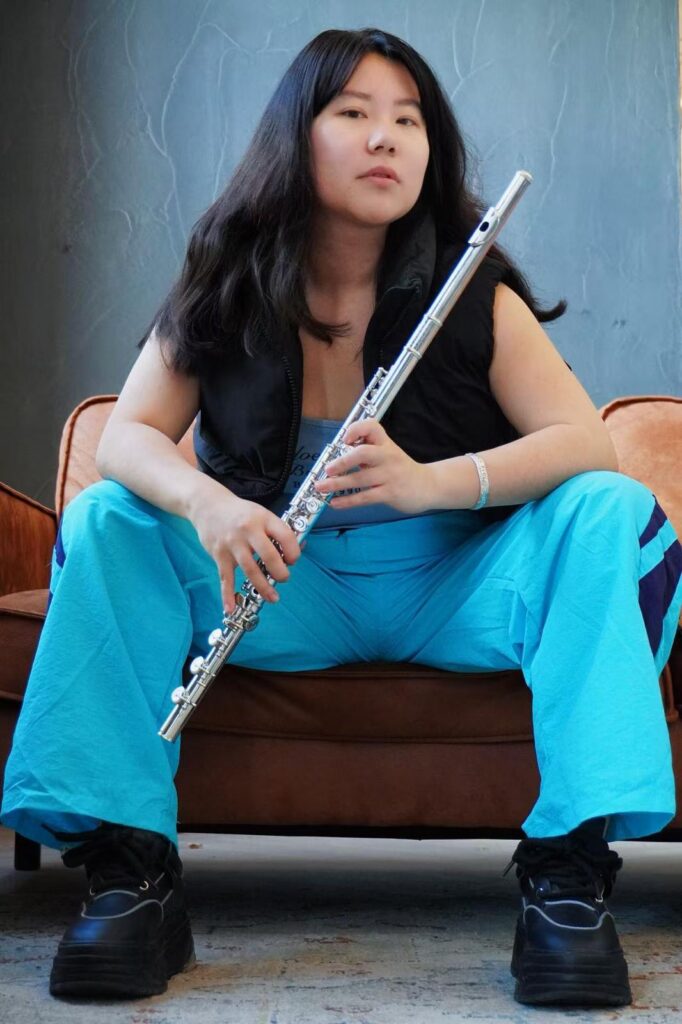
She has been playing the flute since she was five, sings, paints, and acts. After earning a bachelor’s degree in classical flute and voice at the principal conservatory in China, she chose to pursue another bachelor’s degree-partly to truly understand jazz. Thanks to a generous scholarship, she was able to study at ArtEZ in Arnhem. Being versatile and open to the world is her passion and life’s purpose – so much so that Zheng Qisheng (26) chose a fitting stage name in the Netherlands: Qniverse. We spoke with this passionate, candid artistic jack-of-all-trades over coffee and apple pie in Amsterdam
She was five years old and couldn’t stop singing all day long. Too much of a good thing, thought her mother. So when a friend unexpectedly offered her a flute, she seized it with both hands. That would surely keep little Qisheng busy! And indeed it did. Anyone who has ever tried playing a flute knows how fiercely difficult it is to produce any sound at all. But the toddler enjoyed it and succeeded. “I loved it,” tells Qisheng.
Next, she ended up in an after-school flute class. Looking back now, she laughs merrily: “Can you imagine: twenty-five flutes together, most of which were also defective. What a terrible sound that was, and what total chaos! Many children dropped out quickly.”
In addition, Qisheng took private flute lessons. That went so well that she got into a specialized school combining general education with intensive music lessons. From there, things moved fast. Teachers encouraged her to enter competitions, even as far away as Russia. Prizes kept coming, and at fourteen, she won a major prize: admission to the top music institution in China, the Central Conservatory of Music in Beijing, whose alumni include star pianist Lang Lang and famous singer Peng Liyuan, the wife of supreme leader Xi Jinping.
“It was a journey of over twelve hours from our city. I landed in a completely different world. In Wuhu, along the Yangtze River and not far from Nanjing, there is an atmosphere of ‘the good life.’ None of the hectic pace and work pressure that often prevails in China. It’s a place chosen by poets like Li Bai from the Tang dynasty to spend his final years, for instance. Teahouses are everywhere, along with small musical street performances featuring the erhu, guzheng, and singing. Not many people leave Wuhu, so when I did and went to that famous conservatory, it was all over the local news!”
“That other world was also present in the campus room I shared with three others. During the first few weeks, I couldn’t understand a single word of the phone calls my classmates had with their families back home in dialect. So when I received scholarships after my bachelor’s to study at the ArtEZ conservatory in Arnhem, Netherlands, it didn’t even feel like a massive culture shock,” Qisheng laughs.
She chose not to pursue a master’s degree in Beijing, but to take on another bachelor’s degree instead. The reason: she wanted to do more than study classical flute and voice; she was curious about jazz. “At Chinese conservatories, they only teach classical music. There are jazz academies now, but those are private institutions and not affordable for everyone.”

Artistically, she developed and broadened her horizons rapidly. With an ArtEZ Bachelor’s degree in hand (June 2025), she doesn’t just play music and compose – she writes poetry, paints, and acts. On September 11, for instance, she will perform in the music theater production All The Lonely People at ITA Amsterdam, which has been nominated for the new Music Theater Prize. It is an ode to people who die in total isolation, based on the story series De Eenzame Uitvaart (The Lonely Funeral) by Volkskrant journalist and poet Joris van Casteren. Qisheng: “A beautiful project and wonderful to participate in, also because it helps me get to know Dutch society better.”
Musically speaking, she also has a busy schedule. She plays solo, in a duo, a trio (Q’s trio), and together with four Dutch musicians in her group, Q-tet.
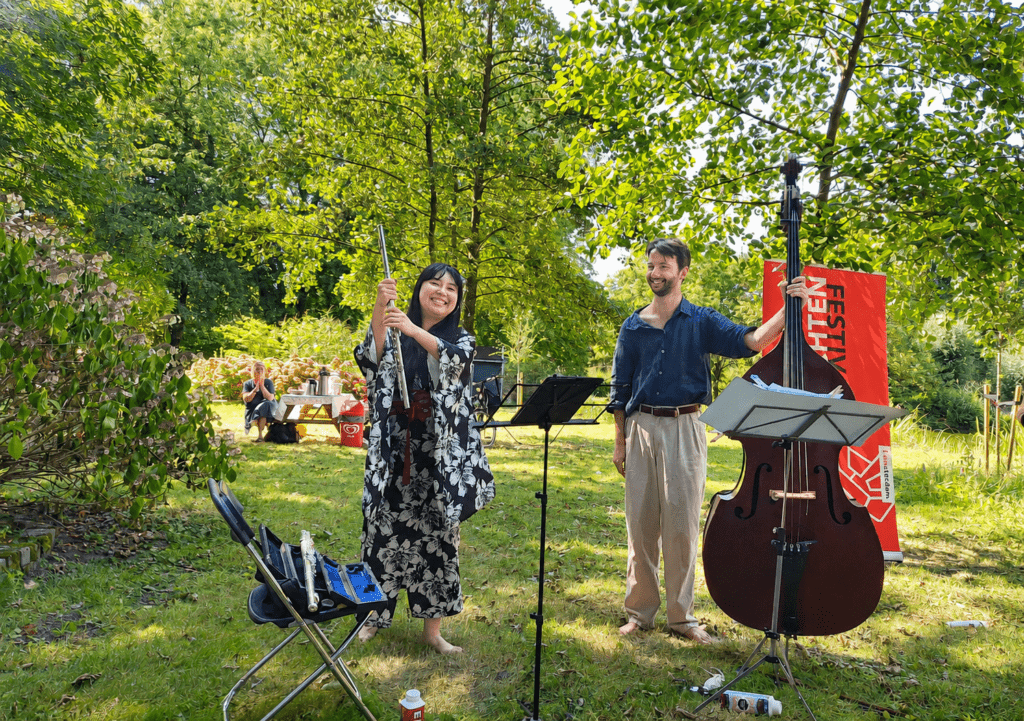
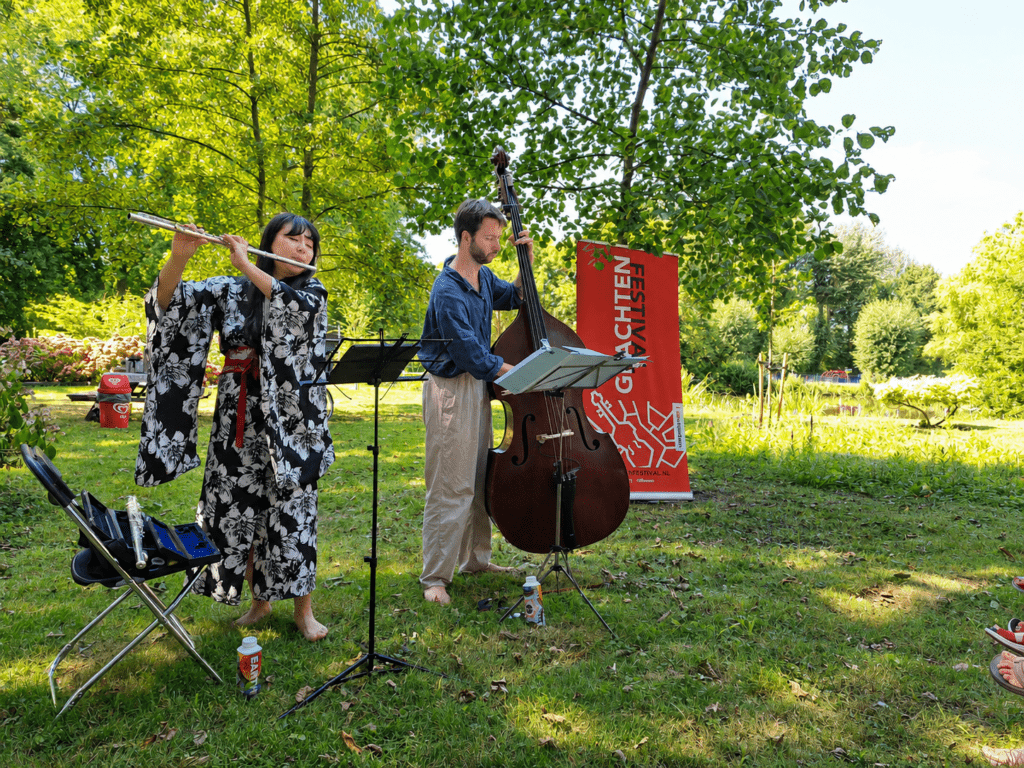
Earlier this year, she played at the North Sea Jazz Festival and had a short conversation with Queen Máxima. In August, she had performances at the Grachtenfestival with double bassist Tijs Klaassen – a fusion of jazz and traditional Chinese music. In November, she will perform modern jazz mixed with Chinese music at Rockit in Groningen with her Q-tet formation.
“I am very happy in the Netherlands, especially with the wonderful group of diverse musicians around me; they are truly friends. It’s a great atmosphere. I have a very interesting life. I hope to be able to stay in the Netherlands for a few more years. I am currently in the visa process that the Netherlands offers specifically for artists.”
Meanwhile, her first CD is on the way: Am I Alive?. In 2027, she will go on a tour in China. She previously did so in 2025, discovering that venue doors in China opened wide for her as an alumna of the Beijing conservatory. For example, she has already played at the famous Blue Note in Beijing.
Qisheng: “I want to do more than just perform there. In workshops for music students, I want to show what we do in the Netherlands with jazz and fusion forms with Chinese music, and play together with them. I’ve noticed that interest in ‘East meets West’ in music is gradually growing. Bach with Chinese lyrics, or violin alongside the erhu. To me, that is now second nature – I am that combination,” she laughs.
Furthermore, Qisheng wants to emphasize that musical developments in China are certainly not standing still. For instance, she notices plenty of experimentation with AI in the music world. “In China, people are more open to it than in the Netherlands, I notice. Personally, I am neutral about it and certainly not afraid. AI will never be able to replace human-made compositions. I mainly think it will make original compositions even more special and in demand.”
One final question: Brazilian and Arabic music programs have become well-established at Dutch conservatories. Is there also interest in Chinese music, which is built on a completely different foundation than Western harmony?
Qisheng: “I am certain there are teachers who would love to do that, but on the other hand: schools first want to know if there are actually students who want to learn it. I think that takes time; after all, the introduction of Brazilian courses didn’t happen overnight either.”
Finally, she mentions a big difference between China and the West in professional music: “In the West there are famous musicians, think of Mozart and Beethoven. In China, there are virtually none. There they are more broadly oriented artistic people, who are also poets or painters, for example, we call them wenren (文人). A bit like Da Vinci in the past”.
——————————————-
Website van Zheng Qisheng / Qniverse https://qniverse.art/
Links to her songs https://qniverse.art/music/Insta: qniverse_zheng
She will perform soon:
11 September 2026: in the theatre production All the lonely people, ITA, Amsterdam
14 November 2026: festival Rockit, Groningen