
A Spicy Edition of the VNC China Dining Club
by Astrid Bouwman
Friday evening, July 10, peak of summer in Rotterdam. Guests trickle in one by one at restaurant Sānsān, seeking some relief at a table equipped with air conditioning. By 6:30 PM, the table set for twelve turnis out to be overbooked, and we squeeze together to accommodate two more guests. As an icebreaker, Sichuan pepper and slices of dried Spanish chili peppers appear on the table – the key flavor profiles of this restaurant. Nibbling on the pure Sichuan pepper initially leaves a fresh, citrusy taste on the tongue, but moments later, a numbing sensation sets in that lasts for a good five minutes. Fortunately, the processed version has a milder effect.
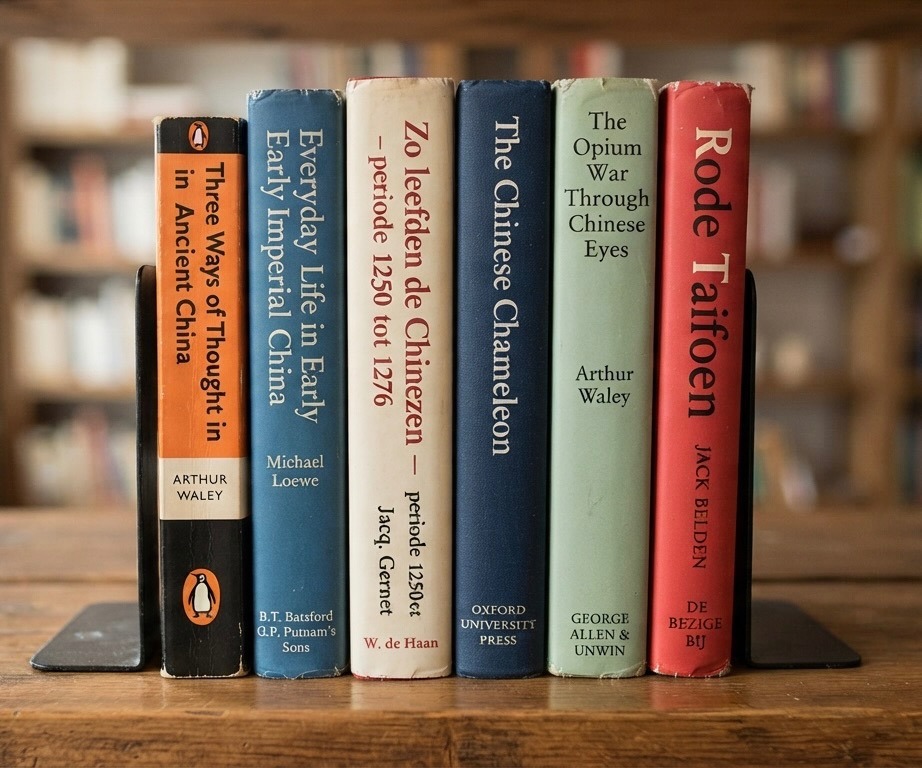
Tonight’s cultural component consisted of six historical books. Aside from Chinese food, host Oey Toen Ping also has a great love for read,ing, especially when the reading material revolves around China. The books he presents share the common trait that daily life and Chinese worldview (philosophy) are explored in depth – something he often finds lacking in modern literature. These books cover a vast span of time, and an interesting question while reading would be to see how daily life has changed through history, and what remains recognizable as typically Chinese. In chronological order:
Three Ways of Thought in Ancient China (Arthur Waley)
Covers the period from roughly 500 to 200 BC. A brilliant introduction to Confucianism, Taoism and Legalism during the Warring States period.
Everyday Life in Early Imperial China (Michael Loewe)
Covers the period from 202 BC to 220 AD, providing a detailed picture of daily life, social hierarchy, and bureaucracy during the Han Dynasty.
Daily Life in China on the Eve of the Mongol Invasion, 1250–1276 (Jacques Gernet)
A masterful reconstruction of life in Hangzhou on the eve of the Mongol conquest. This masterpiece is still regarded as one of the most atmospheric books ever written about the Song Dynasty.
The Chinese Chameleon (Raymond Dawson)
Spanning the 13th to the 20th century, a fascinating analysis of how Western thinkers have viewed China through the centuries.
The Opium War Through Chinese Eyes (Arthur Waley)
A unique perspective on the First Opium War, (1839 to 1842), based on diaries and texts from Chinese historiography.
Red Taifoon (Jack Belden)
A poignant eyewitness account of the Chinese Civil War and the rise of the communists (1946 – 1949).
These books are no longer for available in regular bookstores, but can certainly be found on the second-hand market or in (university) libraries.
In addition, we are shown two Western classics, sold as special editions in China: George Orwells Animal Farm and 1984. Both books consist of two parts with a Chinese text alongside an English translation, intended for learning English.
With our hunger for knowledge satisfied, the starters quikcly made their way to the table: three cold dishes, one with tofu (soft with preserved egg), one with noodles (wide rice noodles in a spicy-sour sauce), and one with pork belly (thinly sliced with a garlic-chili sauce). For 14 diners this turned out not to be enough, and the last one was chosen for a refill.
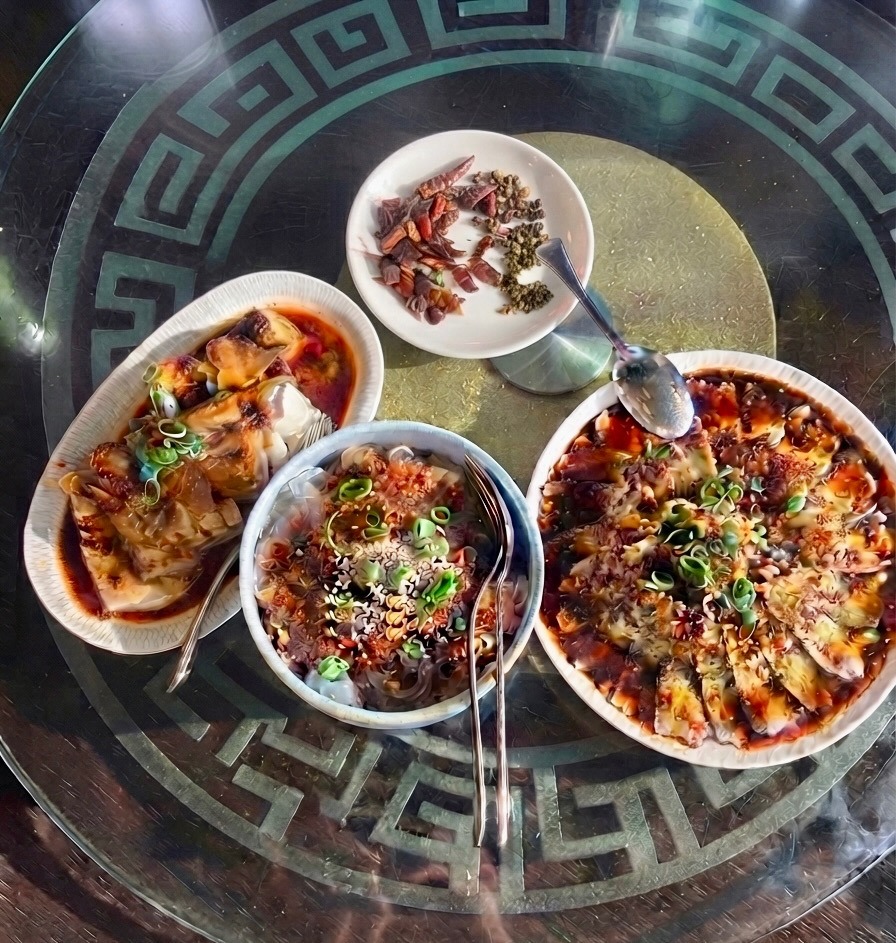
After that, the kitchen really heated up and things moved fast. One steaming dish after another appeared on the table, with empty bowls swapping places for full ones. Host Oey Toen Ping once again provided a well-balanced selection from the very extensive menu. That menu deserves an honorable mention by the way: it reads more like a coffee table book with stunning photography than a standard menu, and it invites exploration far more than the ubiquitous QR code.
It is an impossible task to review every single dish of the evening, but to give an idea here are a few highlights: the fresh-sour Miao fish soup containing both fish and pickled cabbage, the surprisingly tender lamb with cumin and pepper, the authentic Mapo tofu, and the Sichuan-style stir-fried green beans with minced meat. The meal concluded with Basi pingguo: caramelized apples. This had to be attacked immediately, because as soon as the caramel cools down, it becomes impossible to separate the pieces of apple.
This dessert is not on the menu, but the cook turned out to have the ingredients and expertise to prepare it for us. The fact that the chef prepared this dessert especially for us was indicative of Sānsān’s hospitality. It was an unexpected and sweet end to a rich evening that, despite the hustle and bustle at the table, was very successful. With full stomachs and enriched minds, we said our goodbyes and are already looking forward to the next edition of the VNC China Dining Club on August 14, 2026, in Amsterdam.


