by Vici Gao
Since I moved to the Netherlands, I have noticed something strange.
People here rarely talk about AI in the way they do in Silicon Valley. There is no wave of AI base model start-ups, no local OpenAI. In the cafes of Eindhoven, people still talk about football, house prices and the coming summer holidays. And yet almost every advanced AI chip in the world, even before it exists, must first pass through the Netherlands.
The secret center in the Netherlands
In 2021, MIT researcher Andrew McAfee mapped out the fifty most valuable tech companies in the world. The American west coast formed a dense cluster of green bubbles: Amazon, Apple, Google, Microsoft. There was exactly one such bubble on the entire European continent. Silicon Valley investor Steve Jurvetson looked at the map and summarized it concisely: Europe had one green bubble left, and that was ASML.
In early June, Elon Musk posted a message on X that quickly attracted 1.3 million views: ASML should be nurtured and supported; it is clearly the largest company in Europe. That was not a non-committal compliment. Days later, Musk was invited to ASML’s internal technology conference, where he crossed swords with CEO Christophe Fouquet to lobby for his own chip manufacturing project Terafab — an initiative jointly backed by Tesla, SpaceX and xAI — which ASML’s EUV (Extreme Ultra Violet) machines need to get off the ground. The same month, SpaceX went public on the Nasdaq, where it closed its first day of trading at a valuation of more than $2.2 trillion after raising $75 billion: the largest initial public offering (IPO = Initial Public Offering) in history.
If the AI industry is a gold rush, then the scarcity shovel is not in Silicon Valley, but in the Netherlands. To be more precise: whether it is Nvidia, TSMC, Samsung or SK Hynix, anyone who wants to produce an advanced chip must first go through ASML. This is not a metaphor, but the sober reality within the global semiconductor supply chain. ASML is the only company in the world that can produce EUV lithography machines on a large scale, which provides a de facto monopoly on the equipment needed for the most advanced chip nodes.
A visit to ASML is not on the bucket list of tourists. But for any company that wants to build advanced chips, it is the most important place of pilgrimage in the world.
The shovel sellers reign supreme
Every technology revolution follows the same arc: someone builds the infrastructure and sells shovels, then compression technology makes that infrastructure usable, and only then does mass commercial adoption follow. The enthusiasm splashes from top to bottom, layer after layer, and the closer a layer is to the end user, the more valuable it usually becomes – but only if you survive the first layer.
Currently, the rollout of computing power is in the second half, and this is the most expensive phase of the race so far. Google recently committed another $40 billion to Anthropic – 10 billion of which will be direct and 30 billion in a subsequent stage – entirely dedicated to the purchase of GPUs (Graphics Processing Unit). That money is not intended for Anthropic’s operational costs, but for hardware.
Nvidia posted a net profit of $58.3 billion in the first quarter of its broken 2026 financial year, up 211% year-over-year. Over the past 16 months, Jensen Huang has invested roughly $90 billion in 145 companies; He no longer just sells shovels, but uses the proceeds to buy shares in the mine itself.
The next focal point has now spread to memory chips. SK Hynix recorded revenue of $52.6 billion in the first quarter of this year, up 198% year-over-year. Samsung reported revenue of $97.3 billion over the same period, with operating profit increasing by 756%. Bank of America has labeled 2026 as a supercycle similar to the 1990s. And the new factories that both companies are building will run on ASML’s EUV machines.
On July 15, ASML published its results for the second quarter of 2026: quarterly revenue of 9.3 billion euros, net profit of 2.9 billion euros and a gross margin of 54%, far exceeding expectations. This was the third upward adjustment of the annual forecast this year, which has now been set at 43 to 45 billion euros. Fouquet spoke plainly: “AI-powered demand exceeds supply.” ASML’s market value has now passed the 610 billion euro mark, making it the most valuable listed company in Europe.
British investor James Anderson has argued that the trillion-dollar wave of AI investments will disproportionately benefit a select group of hardware vendors: Nvidia, TSMC and ASML. That prediction is confirmed quarter after quarter. Models and applications still make headlines, but the structural gains continue to land in the hands of the few companies that no one can ignore.
Europe’s other two assets
But if ASML was Europe’s only asset, this story didn’t amount to much. Europe does not own companies like Nvidia or OpenAI. Nevertheless, Europe is still holding on to a number of unique AI maps that cannot simply be copied. In addition to its advanced lithography equipment, it possesses the world’s most thoughtful regulatory framework for AI and a sovereign model ecosystem around Mistral.
The first trump card is regulation. The EU AI Act (the European Artificial Intelligence Act), which came into force in August 2024, is the world’s first comprehensive legislation in the field of AI governance. Many initially saw this as another example of European bureaucratic self-control. However, you can also look at it differently: Europe is reverting to a tried and tested instrument – the norm-setting power with which it already impressed ten years ago with the GDPR (General Data Protection Regulation), the European privacy legislation. The logic of this was crystal clear: anyone who wants access to the European market follows the European rules. A decade later, that approach has become the global standard for data governance, which neither Silicon Valley nor Beijing can ignore.
The AI Act attempts to follow the same route. Last month, Austrian State Secretary Alexander Pröll proposed to the European Commission to invite Anthropic to operate within the EU. The reasoning was straightforward: because American export restrictions and trade rules restrict freedom of movement in the US, some tech players are seeking refuge in the open European market.
The second trump card concerns sovereign models, and that strategy only really works when the first trump card (the legislation) is already on the table. The United States opted for a closed approach: the technology and the underlying source code are kept strictly secret behind paid digital doors (APIs = Application Programming Interfaces), while maintaining maximum control. China, on the other hand, opted for an open-source offensive by giving the technology away for free, in order to gain ground worldwide and buy political influence. Europe, on the other hand, is opting for a third path: using open source as an instrument for its own sovereignty and control.
That path runs through Mistral, founded in Paris in 2023 by three researchers who left DeepMind and Meta. The company releases its flagship models as open source – any organization can download the underlying code, run it on its own servers, monitor it, or disable it as it pleases. In a Europe that has already built a framework for data sovereignty through the AI Act, that kind of control is worth more than any shielded API access. Earlier this year, Mistral raised 830 million euros in institutional bonds to build a hyperscale data center in Paris – the first time a European AI company financed supercomputer-grade infrastructure without U.S. venture capital. Annual recurring revenue (ARR) grew from roughly $20 million at the beginning of 2025 to $400 million at the beginning of 2026, a twentyfold increase in just one year.
The deal that closes the circle took place in September 2025: ASML invested 1.3 billion euros in Mistral for an 11% stake, making it the largest shareholder. A Dutch hardware company that supports a French model company – the physical base and the software layer united in a single stock transaction.
Where the previous internet cycle was won on the basis of user scale, this cycle is more like a capital-intensive industrial showdown. Model capacity remains as important as ever, but what increasingly determines the outcome is the combined weight of computing power, energy, capital and supply chains. ASML, the AI Act and Mistral together form the most well-considered strategic position that Europe has built up in years.
Guarding the gate, but missing out on the profits
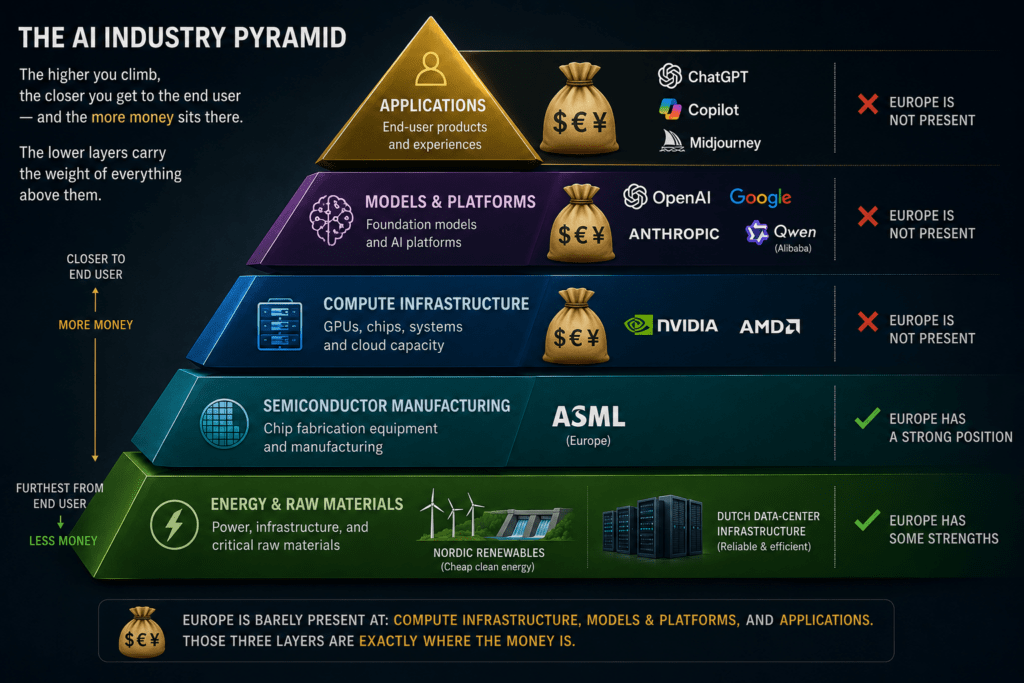
Think of the AI industry as a pyramid. At the base are energy and raw materials, followed by semiconductor manufacturing, the compute infrastructure, models and platforms, and at the very top are the end applications. The higher you climb, the closer you get to the end user – and the more money you can make there. The lower layers bear the weight of everything that rests above them.
Where does Europe stand in this picture? In the field of energy, it has only foundation – cheap Scandinavian renewable energy and Dutch data center infrastructure. For semiconductors, it has ASML. Above that, the computing power is in the hands of Nvidia and AMD, the models belong to OpenAI, Google, Anthropic and the Chinese Qwen. The applications are dominated by ChatGPT, Copilot and Midjourney. Europe is virtually absent from those top three layers – and it is precisely in those three layers that the big money is.
According to figures from global investment platform Gelonghui and data analyst GoguData, global AI profits are expected to reach $637 billion by 2026. The US takes 314 billion dollars of this, with Nvidia alone accounting for 207 billion dollars. South Korea, supported by SK Hynix and Samsung, accounts for 223 billion dollars. Taiwan and mainland China jointly claim 73 billion dollars. The European share is 13.7 billion dollars – roughly comparable to Japan, and 600 times smaller than that of South Korea. Of that 13.7 billion dollars, 7.3 billion is accounted for by ASML alone. All other AI-related companies in Europe together account for the remaining $6.4 billion.
Europe has kept a firm grip on the bottom layer of the pyramid. But it has hardly benefited from the proceeds of the three layers above. This is not a new problem. Cisco once sold the routers that made the internet possible; an indispensable infrastructure company that no one could ignore. Then Google, Facebook and Amazon grew into market values that made the era of Cisco pale into a far introductory chapter.
The sellers of shovels usually earn the best in the first wave – but the true fortunes are never to be found in the shovel itself during a gold rush. And now that shovel is even being pulled from both sides of the Atlantic. The U.S. Congress is preparing legislation known as the MATCH Act, which will require allied countries to align export restrictions on chips to China — with ASML explicitly mentioned by name in this law. Since April, the US Secretary of Commerce, Howard Lutnick, has been in private talks with ASML’s management because of suspicions that an EUV machine would have ended up in China through underground channels. ASML has firmly denied this and submitted documentation to Washington, in which all 314 globally operational EUV systems have been carefully maintained; none in China.
This pressure is also reflected in the hard figures: Sales of ASML systems to China fell from 36% of the total in the fourth quarter of last year to 19% in the first quarter of this year.
ASML’s lead does not go unchallenged either. On July 27, Reuters reported that a state-backed Shanghai company, in partnership with SiCarrier and Huawei, has begun mass production of homegrown DUV lithography machines, with planned deliveries to SMIC and Hua Hong. Shares of ASML fell by about 12% in two days, which evaporated $44 billion in market value.
But what is being made is DUV, built for more mature (older) chip process nodes. The advanced chips that run AI still need EUV — and ASML is still the only one who can build that. The difference in scale is also large: five units this year compared to ASML’s own annual production of more than a hundred. The real hurdle was never building the machine itself. It’s all in the yield (the yield of usable chips per wafer), and that takes time that cannot be bought with any shortcut.
The reaction of the market is nevertheless worth following. The decline does not mean that ASML’s lead has weakened — it means that investors are reconsidering how long that defensive wall will hold. On the one hand, Washington continues to tighten export restrictions. On the other hand, China’s advance in the production of mature chips has become a variable that valuation models can no longer ignore.
ASML is still at the absolute center of global advanced chip production. The question now is not how far ahead it is, but how long that lead can last.
More than half of the capital flowing into the growth phase of European AI start-ups comes from US investors. Europe is incubating the talent; America collects the returns. An apt formulation that is doing the rounds sums it up concisely: Europeans consume AI while training someone else’s algorithm. In the end, all these figures merge into a simplistic reality: whose pockets fill up the fastest?
Are borders buying the future?
On Bloomberg’s most recent billionaires list, eight of the ten richest people have amassed their fortunes in the tech sector, seven of whom are American. The only European in the top ten is Bernard Arnault – a luxury goods magnate who has no connection to AI.
The contrast with the prosperity that is created on the other side of the world is stark.
This month, Chinese AI start-up DeepSeek raised a new funding round, valuing the company at nearly $71 billion before this investment. Founder Liang Wenfeng’s net worth skyrocketed to $36 billion, making him the richest self-employed AI founder in the world, ahead of OpenAI’s Greg Brockman and Anthropic’s Dario Amodei. Two months earlier, his net worth stood at only $16.7 billion – in three months, DeepSeek’s valuation rose from 10 billion to 50 billion and then on to more than 70 billion dollars.
History shows that those who set the boundaries or frameworks do not automatically win the future. Rome built the legal architecture; Prosperity eventually flowed to the new realms of maritime trade. Europe designed the GDPR; the economic gain was for Silicon Valley. This time, ASML, the AI Act and Mistral together represent Europe’s toughest strategic bet yet in the AI era. But the ledger account of 637 billion dollars is already on the table – and a strategic bet is by no means the same as a guaranteed payout.
The US and China are fighting each other for the future of artificial intelligence. In the meantime, Europe is drawing its legal boundaries. The question is whether those limits are sufficient to secure a lasting share in that future. In 2026, there is no clear answer to this yet. What is certain is this: never before have so much capital and human intelligence flowed simultaneously to a single focal point. Looking back, twenty years of the internet was just the warm-up round. This race is heading for something bigger – the underlying operating system of civilization itself.
And the physical gateway to that operating system is currently in a quiet Dutch city. However, the financial loot that Europe is bringing in remains remarkably modest. And whether it will be allowed to continue to guard that gateway in the future is no longer entirely in European hands.
Abbreviations used in the text:
- EUV = Extreme Ultraviolet (Lithography, ASML’s chip production technology)
- IPO = Initial Public Offering
- GPU = Graphics Processing Unit (A specialized processor that is crucial for AI compute loads)
- GDPR = General Data Protection Regulation
- API = Application Programming Interface (A software link that allows different applications to communicate with each other)
—————————-
Vici Gao is a freelance business journalist based in Eindhoven, with more than eight years of experience in reporting technology, venture capital and China-Europe economic relations for Chinese media.