
by Xixi Wang
In the autumn of 2026, VNC will organize a group trip to China centred on the theme Healthy Living in China, exploring topics such as exercise, nutrition, and preventive healthcare. In preparation for this journey, XiXi Wang has written a three-part series on healthcare in China for this website. In the first article, Xixi Wang discussed China’s evolving health landscape in regard to the national policy reform. (https://www.vnc-china.nl/de-hoest-van-oom-chen-en-de-transformatie-van-de-chinese-gezondheidszorg) This article informs us about the boom in modern wellness trends.
What do 94% of Chinese consumers have in common? The belief that wellness matters. In an era of global economic uncertainty, a fascinating trend is emerging in China. In 2025, McKinsey found that a striking 94% of Chinese consumers view wellness as a “top” or “important” priority, compared with 79% in Britain and 84% in the United States. Even amid macroeconomic volatility, 64% of Chinese consumers said they would maintain or increase their wellness spending.
A Global Wellness Conversation
In addition to these timeless traditions, a new generation of well-being trends is emerging, which resonate just as strongly in Amsterdam, New York or Dubai. Chinese consumers are also increasingly seeking preventive health in pill form, and the numbers don’t lie: the dietary supplement market reached RMB 312.4 billion in 2025, up from RMB 148 billion in 2016 – a compound annual growth rate of 8.65% – with vitamins and minerals accounting for a 55.4% share. Marathon running has also become popular: from just 22 CAA-registered events and 400,000 participants in 2011 to no less than 594 registered races and 4.54 million runners in 2025; the sound of a nation that breathes out step by step. And for those seeking their health further from home, wellness tourism tells its own story: China accounted for 8.2% of the global market in 2025, and by 2035 it is expected to lead the Asia-Pacific region with sales of USD 231.6 billion, growing at an annual rate of 11.1%.
Supplements. Marathon running. Well-being tourism. They show that Chinese consumers are fully part of a global conversation about well-being. In addition to these internationally known activities, a pronounced local well-being trend is taking place, rooted in its own soil, its own traditions and restless creativity.
In the remainder of this article, we’ll look at three indigenous Chinese trends: urban camping, TCM makeup, and punk well-being. They are traditions reinvented and packaged for a generation that yearns for heritage with a twist, healing with a touch of indulgence, and self-care with a playful edge.
Trend 1: Urban camping, reinvented
In traditional Chinese painting, one of the most persistent motifs is the solitary figure in the midst of mountains and streams, a minuscule, almost insignificant figure that is dwarfed by nature. This image embodies a cultural ideal of tranquility: man who finds peace through direct, tranquil contact with nature, humbly present in a world many times larger than himself.
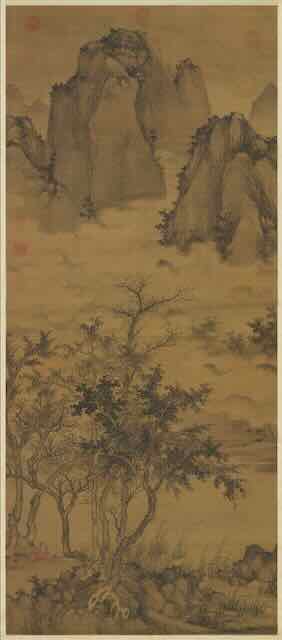
In the old days, Chinese literati escaped the noise of the court by disappearing into the hills, finding clarity in the company of rocks and streams. Today’s city dwellers still love hiking and long vacations, but for an evening or half-day escape from their open-plan offices, they have a new hobby: setting up tents in city parks.
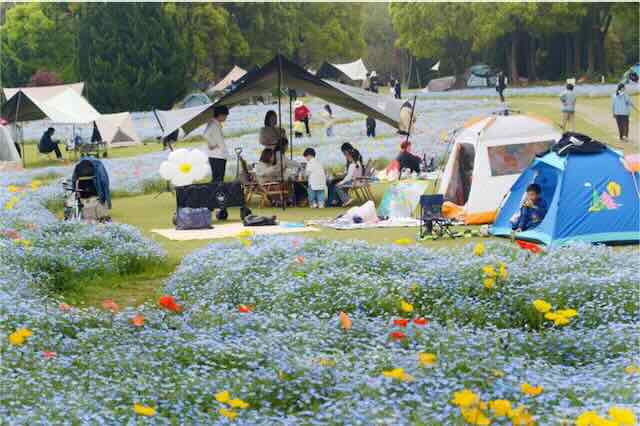
What do these urban campers do? Food is central to the experience. Barbecuing is common, but the most characteristic activity is eating hotpot and making tea in the tent, complete with portable cooking appliances and a range of ingredients. In addition to food and drink, they do camping+: frisbee, playing board games, karaoke in the open air, watching outdoor movies or attending small concerts. Unsurprisingly, shooting and creating social media posts are central to the experience. Everything has been carefully arranged to be photogenic, turning camping into a shared lifestyle statement.

Comfort, aesthetics, and community: Urban camping is a way to bring modern social life to nature, and it’s incredibly popular. Although there is currently no separate category of “urban park camping” in official statistics, the core of China’s camping economy reached a value of RMB 213.97 billion in 2024 and is expected to surpass RMB 248.32 billion by 2025. Including transportation, hospitality, and equipment, this powers an estimated total market of RMB 1.44 trillion.
Ancient wisdom already understood that the mind comes to rest in nature. Modern life hasn’t changed that truth, just the setting, the company, and the menu. Still escaping, still looking for clarity and relaxation, but now with friends, frisbees, wifi and a portable stove. Tradition, updated for city life.
Trend 2: Beauty gets a makeover from traditional medicine
If urban camping is all about bringing community to nature, then TCM (Traditional Chinese Medicine) makeup is all about bringing nature and healing into daily rituals. For decades, the world seemed to have made peace with a compromise: makeup damages, skincare repairs. That is now changing. Beauty also becomes a health product; Not in the literal sense, but in how consumers think about it.
Although TCM had long been at the heart of the modern skincare industry in China, no cosmetics brand had ever built its entire identity around it – until Florasis (花西子) came on the scene – and with great success.
Since its creation in 2017, the brand has been anchored in “Oriental cosmetics, feeding with flowers” (东方彩妆,以花养妆) from the beginning. This philosophy explicitly combined traditional Chinese aesthetics with botanical skincare. Each product, from lipsticks to powders, was formulated with floral essences (think lotus flowers and peach blossom) and natural, herbaceous ingredients like silk (蚕丝), kudzu root (葛根), and forsythia capsules (连翘). The vision was elegant in its simplicity: wearing makeup should be as nourishing as wearing skincare.

Tradition wasn’t just an ingredient story either. It permeated every aspect of the brand, including product design and the packaging itself: micro-engraved lipsticks, compact designs inspired by embroidery, and palettes that reference traditional folding screens.
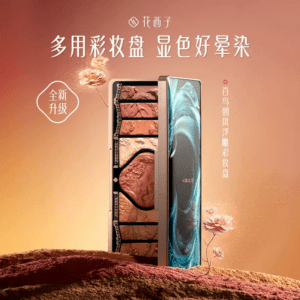
The combination of content and symbolism turned out to be irresistible. In 2021, Florasis surpassed RMB 5 billion (approximately €646 million) in annual sales. At its peak, the brand had a market share of almost 7% in the Chinese market for color cosmetics. The meteoric rise of Florasis proved that Chinese consumers were hungry for a beauty product that matched their well-being and cultural preferences, in the language of TCM and holistic well-being.

The story also contains a warning. In recent years, the brand has faced controversies over product quality and PR setbacks, reminding the industry that tradition is not a marketing shortcut. Claims rooted in wellness and heritage create expectations that must be supported by ingredients, formulations, and consumer experience.
Medical makeup is centuries old in China. The scale of it is not. Florasis proved that it could be done: standardized formulations, industrialized packaging, brand stories that transform tradition into a new ambition for the masses, all while raising the bar for an entire industry. Bringing heritage on a large scale and with integrity is a delicate and difficult art. But if it succeeds, it’s heritage with a twist. Centuries old, but unmistakably new.
Trend 3: Well-being meets indulgence in punk-well-being
Another vibrant expression of “heritage with a twist” in the Chinese wellness scene is the phenomenon known as punk welfare (朋克养生). It’s the art of self-indulgence with a touch of self-redemption: partying lavishly while drinking goji berries, and staying up late while wearing the most expensive face mask. It’s not so much about being healthy; It’s about feeling less guilty about unhealthy behavior.
For young Chinese workers, the evenings remain their only real ‘me-time’, so TCM bars seem to offer a compromise: having fun while trying to limit the damage. In bars like Niang Qing (酿青) and Zhihe (知合) in Shanghai, customers first sit with a licensed TCM practitioner who feels their pulse, looks at their tongue, and assesses their constitution. The practitioner writes a ‘recipe’ that the customer then gives to the bartender. The mixologist creates a custom cocktail with spices and roots from the apothecary drawers that adorn the walls: goji berries, angelica, dried tangerine peel, rose, cinnamon, ginger, and astragalus. The trend has gone viral on both domestic and international social media platforms. What was once a bitter medicine is now a night out.
Sugar is of course also a favorite choice for a sweet sin. Take Zhong Yao Tang (忠曜堂), an ice cream parlor that opened in the summer of 2024 in the former French concession of Shanghai. The storefront looks like a traditional Chinese pharmacy, with walls full of wooden drawers and the faint smell of spices in the air. But instead of providing bitter decoctions, they serve ice cream in flavors like mung bean, ginseng, jasmine, smoked plum, hawthorn, medlar syrup, and many more. The brand has now expanded to 10 stores throughout China.
Ice cream is hard to resist, but what about unlimited Häagen-Dazs, hot springs, massages, aromatherapy, a cinema, a cocktail bar and a PS5 gaming center, all under one roof? That’s the new offering of China’s 24-hour urban wellness centers, where centuries-old wellness traditions meet modern indulgence. These sprawling retreats still honor the heritage of therapeutic bathing; Mineral baths, expert massages and aromatherapy remain at the core. But many are now adding an irresistible twist: all-you-can-eat buffets full of seafood, desserts, fresh fruit, soft drinks and, of course, ice cream. Healing nowadays, it seems, comes with a side dish of lobster and a scoop of Häagen-Dazs.
Well-being should be enjoyable for today’s city dwellers. Whether these treatments are medically transformative is almost irrelevant; What matters is that they make self-care modern, social, and lighthearted. In China, health has always been understood holistically, as a balance of body, mind and spirit, so perhaps there is something old and deeply wise in making self-care not a chore, but a pleasure.
The bigger picture
My first article was about the Healthy China 2030 policy, how it sets the ambition to make health a pillar of the national economy, and the many milestones since 2016. But no single policy prescription could have directed the inventive, bottom-up explosion of welfare services and products that are now reshaping the market.
From urban camping and TCM beauty to punk wellness; Heritage continues to exist in the literary retreat in nature, in herbal and botanical wisdom, and in the therapeutic rituals of bathing and healing. An entire generation is breathing new life into these traditions with creativity and humour, as tools to endure the sky-high pressures and expectations of modern working life.
These are small, pleasant moments of relaxation that are feasible for an overworked workforce to maintain. In this light, heritage with a twist is not a dilution of traditions, but its pragmatic evolution: a quiet, smart and highly market-oriented redevelopment of ancient wisdom so that they fit into the wallets, schemes and minds of the people who need it most.

Xixi Wang is from China and is an alumna of a Dutch university (BA Social Justice & Philosophy, CA/NO; Research MA Gender Studies, NL). As the founder of CUE (since 2020), she sees supporting people during crucial phases of life as her life mission. She is passionately committed to cross-border knowledge sharing and the promotion of equal opportunities in healthcare. Her previous research-based articles have reached more than 20 million readers in China and the United States. Also check out the CUE website: https://cuelifetransition.com
References
Wang, J., Hou, T., Chen, C., & Pione, A. (n.d.). 年轻世代催热全球十万亿元健康市场新趋势 [The younger generation fuels a new trend in the global ten-trillion-yuan health market]. McKinsey & Company. https://www.mckinsey.com.cn/%e5%b9%b4%e8%bd%bb%e4%b8%96%e4%bb%a3%e5%82%ac%e7%83%ad%e5%85%a8%e7%90%83%e5%8d%81%e4%b8%87%e4%ba%bf%e5%85%83%e5%81%a5%e5%ba%b7%e5%b8%82%e5%9c%ba%e6%96%b0%e8%b6%8b%e5%8a%bf/
Ipsos. (2025, December 2). 75% of Dutch people want priority on health. https://www.ipsos.com/nl-nl/75-nederlanders-wil-prioriteit-op-gezondheid
智研咨询. (2026, March 26). 2026年中国膳食补充剂行业高端化转型报告:功能细分、渠道融合与绿色创新 [2026 China dietary supplement industry high-end transformation report: Functional segmentation, channel integration, and green innovation]. 知乎专栏 [Zhihu Zhuanlan]. https://zhuanlan.zhihu.com/p/2020518455267345621
梁璇. (2018, January 29). 马拉松社区化期盼“以小见大“ [Marathon community-building hopes to “see the big from the small”]. 中国青年报 [China Youth Daily]. https://zqb.cyol.com/html/2018-01/29/nw.D110000zgqnb_20180129_1-04.htm
孙海光. (2026, April 7). 去年全国马拉松参赛规模超454万人次 [Last year’s national marathon participation exceeded 4.54 million people]. 新京报 [The Beijing News]. https://epaper.bjnews.com.cn/html/2026/20260407/20260407_A11/20260407_A11_01_1394_2041169672446939138.html
Grand View Research, Inc. (n.d.). China wellness tourism market size & outlook, 2026-2035. https://www.grandviewresearch.com/horizon/outlook/wellness-tourism-market/china


