
by Astrid Bouwman
The eighth edition of the dining club, March 12, 2026, took place for the first time outside the Randstad, below the rivers, in Eindhoven. Given the place where the participants lived, we could have gone even further south, as far as Maastricht, because that is where a large part of the dinner companions came from this evening.
For example, Eindhoven became the center of the Netherlands for a while, and restaurant Chen Jia Yan became the setting for this dinner.

Lesson about Bronze
Our knowledge about bronze was refreshed: Bronze is an alloy, a fusion of copper and tin. The resulting metal combines properties of both and is therefore more useful for all kinds of purposes. This process was discovered and applied in China as early as 2000 BC. The book ‘Masterpieces of Sichuan Bronzes’ that our host Oey Toen Ping shows contains beautiful illustrations of ancient utensils, including masks, weaponry, wine cups, incense burners. Many of these objects were used in rituals. He also shows a number of bronze objects.
First of all, the galloping horse – found in an ancient tomb in the province of Gansu – is put on the table. A bronze copy admittedly, the original has not been allowed to leave China since 2002. The horse gallops with one leg on the back of a swallow, in perfect and graceful balance. It has been the logo for Chinese tourism since 1983 and is of course also in the picture a lot this year – the year of the horse.
A pendant with archaic Chinese characters turns out to be a bronze coin. With modern technology, it is quite easy to find out that this coin dates from the time of the Zhou dynasty (10th century BC to 256 BC).
An antique wine cup on three legs so that it is always stable and with raised rods to prevent the nose from being inserted too deep into the keg.
That bronze is also a metal that appeals to contemporary artists is shown by Ping with the last object. From a distance it has the shape of a tube or a vase, but in front of us is a very lifelike roll of gauze bandage, complete with the characteristic clamp, entirely made of bronze by a Dutch artist from Deventer.


The food: Sichuan dishes with málà thrills
After we have tasted enough of these art treasures, the cook comes to the table with the first bowls. First of all, the specific ingredients of Sichuan cuisine; To be able to add to taste, add a bowl with the pepper flour and a bowl with pepper oil. That turned out not to be necessary, because the chef had responded to our request to prepare a real málà sensation and let us experience the effect of the Sichuan peppercorns: that unique combination of burning and tingling. The rice and tea therefore had to be replenished regularly.
The meal started with three cold dishes, where the level of the cuisine immediately became clear: fresh, prepared just short or long enough, refined flavors with a very attractive presentation:
- Mouthwatering chicken: Chicken swimming in a red chili oil sauce, invisibly cut into slices. This chicken was certainly finger-licking good, as it should be, there were bones in it to chew off. (photo middle)
- Century Egg Tofu: Silken doufu (tofu) surrounded by halved millennial eggs, with the slices of white doufu, decorated with red and green pepper oil, contrasting beautifully with the deep dark green of the loose core (the egg yolk) and shiny translucent brown edge (the egg white). (photo left)
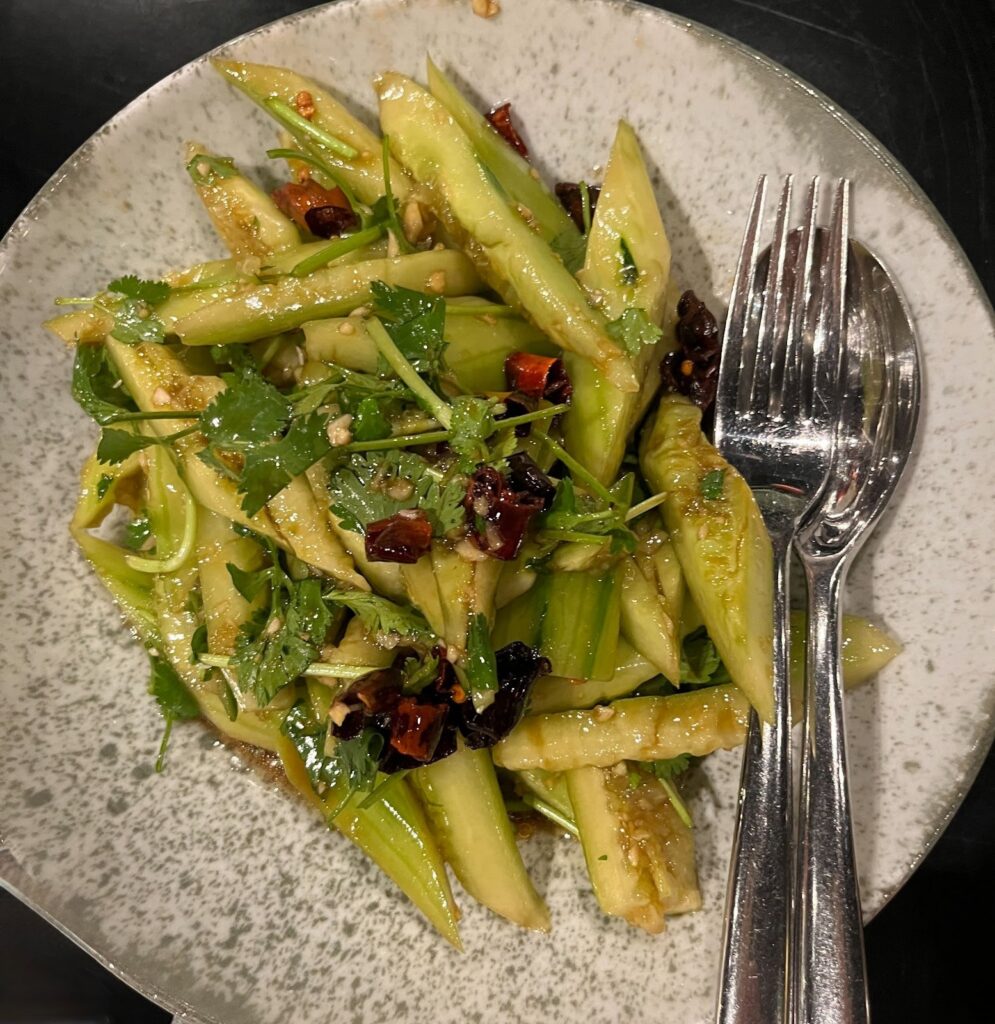
- Refreshing Cucumber: Fresh cucumber in sesame oil, Chinese vinegar and soy sauce, finished with fried peppers and coriander leaf. (photo right)


Then we continued with the hot dishes
- Hot and Sour Soup (酸辣汤): A classic, slightly sour and spicy broth, richly filled with tofu, egg and Chinese mushrooms.
- Cumin Lamb (孜然羊肉): Tender slices of lamb, vigorously sautéed with cumin.
- Sichuan Boiled Beef (水煮牛肉): Wafer-thin sliced beef in a spicy chili broth with large pieces of Chinese cabbage and Chinese mushrooms.
- Dry Fried Spicy Green Beans (干煸四季豆): Crispy fried green beans with ginger, garlic and – of course – peppers.
- Fried Salted Egg Yolk Sweet Corn (金沙玉米): Crispy corn kernels with a silky coating of salted egg yolk, colorfully presented with red and green peppers. A mild counterpart to the spicy dishes.
- Paksoy: Briefly stir-fried in an aromatic garlic oil.
- Kung Pao Shrimp (宫保虾球): Deep fried shrimp balls in a classic sweet-spicy sauce.
- Mapo Tofu (麻婆豆腐): A dish of silk doufu in a rich, spicy sauce with garlic, ginger, fermented black beans, minced meat and Sichuan pepper.
- Yu Xiang Pork (鱼香肉丝): Strips of pork sautéed in a mild, sweet and sour garlic sauce with red and green bell peppers and mushrooms.
- Sweet & Sour Fried Fish (松子鱼): A whole fish, artfully cut into diamonds and folded outwards, passed through the flour and fried with head and tail. Served with a sweet and sour sauce and crispy pine nuts. (photo middle)


After-dinner
After a pleasant evening with delicious and surprising dishes, all table companions left home satisfied. Who knows, maybe for a VNC Eetclub edition in Maastricht. Hopefully Ping will soon find a suitable restaurant with authentic Chinese dishes to hold an edition of the VNC Eetclub.
In addition to organizing meetings with an educational and culinary element, Ping has another motivation for this eating club. Namely, ensuring that Chinese cuisine in all its versatility of dishes and flavors is preserved in the Netherlands. He hopes that participants will also be able to find their way to these restaurants independently and order the original Chinese dishes themselves. After all, when dishes do not ‘run’, they disappear from the menu and in the future there will only be a choice between uniformity and thirteen-in-a-dozen menus.
Also fancy the VNC eating club? The next one is in Rotterdam at restaurant Little Asia, Friday 10 April 2026. You can register via this page.


