
VNC China Dining Club Visits Little Asia
by Astrid Bouwman
A restaurant in Rotterdam North, where tram 6 stops almost right at the doorstep. The name ‘Little Asia’ suggests a modest establishment. In terms of capacity, that’s true – it seats about 30 people. Large posters of the Hong Kong Night Market on the walls create a sense of space and a modern atmosphere. However, the menu is grand, focusing on Cantonese cuisine while makes detours to other regions in Southeast Asia, including Malaysia. It features various authentic Cantonese dishes that are not easily found elsewhere.
For the VNC China dining club, the large round table at the window was set. We welcomed familiar, as well as new, curious guests for whom it was the first time and close to home. For our host, Oey Toen Ping it was a home game and at his favorite restaurant too.
Disguise as an art form
The Rijksmuseum in Amsterdam is currently showing the exhibition Metamorphoses. Ping’s ‘warm-up’ presentation reminded me strongly of it. While the metamorphoses in the Rijksmuseum are based on the stories of the Roman poet Ovid, tonight the teapot – an everyday and essential object in a Chinese context – served as the inspiration for boundless creativity. Ping showed us ‘metamorphosis teapots’ from his collection, made of clay, each portraying something entirely different in both material and function.
We saw teapots posing as wooden crate, rattan basket, a sack of rice – complete with rope reinforcement and small beams underneath to keep the sack dry. There were teapots shaped like steaming basket; leather bag and even a bamboo shed.

One teapot in particular is a fantastic example of the maker’s masterful technique and imagination. Is it made of iron or bronze? Its angular shape resembles part of a building, such as a fortified corner or a monumental gate. The pattern of geometric meanders on the sides is often found on the walls of historic temples and palaces.
The ‘metal look’ is obtained by uisng Yixing clay (zisha), a special type of clay from China. But instead of leaving the clay in its natural reddish-brown color, this teapot has been treated, polished and patinated to create a trompe-l’oeil effect. The deep brown hue, the sheen and the way the corners and edges catch the light perfectly mimic the texture and weight of aged bronze or iron. The ‘Fu’ character (meaning luck or prosperity) in the medallion looks as if it were cast in the metal. It is a ceramic masterpiece that completely deceives the eye.
Culinary Art Perfected
“Authentic dishes with a modern twist, passionate art from the kitchen”, the website promised. After the introduction to metamorphoses, we were not surprised to see dishes appearing on the table in ‘disguise’ as well. Consider, for instance Golden Tofu or Desert Shrimp?
At the host’s request, the dishes were served in phases rather than all at once, as is common in many Chinese restaurants. This gave us the peace to truly taste and appreciate every dish.
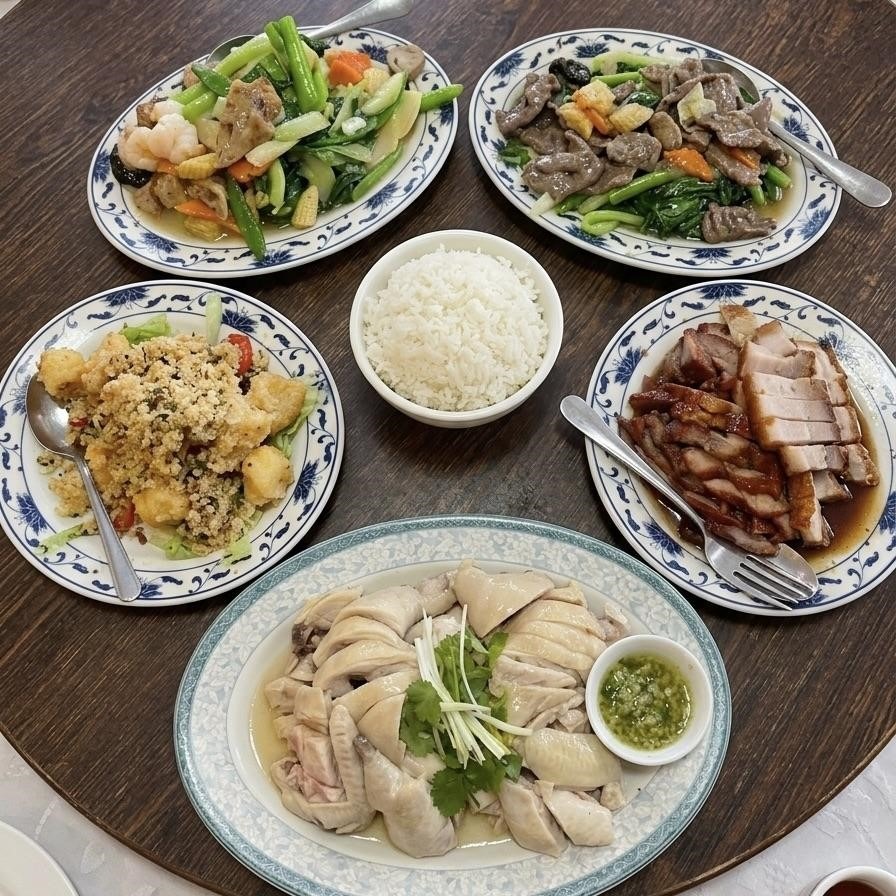
Below is the menu as it was conjured onto our table. You might want to order these dishes during your next family outing*.
Appetizers & Dim Sum
- Tia ha yeun (no. 89): Shrimp balls in a rice flour coating.
- Wan Tan Tong (No. 3): A clear broth with pork and Chinese cabbage. Prepared specifically for this evening with egg instead of shrimp due to allergies.
- Noeng Je Ng Hoeng Yuk Gyun (No. S26): Nyonya spring rolls filled with spiced meat. Connoisseurs recognized the aromatic five-spice powder.

Main Courses: Meat & Fish
- Sie tjoi ngau yuk (no. 65): Tenderly sliced beef tenderloin with various seasonal Chinese vegetables.
- Tjap tjoi ha kou (no. 85): King prawns stir-fried with a colorful palette of vegetables.
- Baak cit kai (No. 97): Traditionally steamed chicken, served with a characteristic dip of ginger, garlic and spring onion.
- Siu mei soeng ping (No. 102): A duo of classic roasted pork belly and lean roasted pork (Char Siu).
- Fung saa ha kou (no. 91): ‘Desert Prawns’, prepared with a crispy coating of breadcrumbs, garlic and peppers.
Tofu specialties
- Juk Seoi Yukzi Daufu (No. 22): Fried tofu in a savory minced meat sauce with broccoli and Tianjin Dongcai (preserved cabbage).
- Wong gam dau fu (no. 79): ‘Golden tofu’; velvety soft tofu coated in a savory layer of salted egg yolk.

Table Manners
During dinner, we discussed some Chinese etiquette: Position the teapot so that the spout does not point directly at a fellow diner The same applies to chopsticks. Gathered around a round table, this proved to be quite a challenge. Tea cups should never sit empty and attentive table companions constantly refill each other’s cups. Even if a guest is not much of a drinker, a tiny drop is added for the sake of form, as skipping someone is considered impolite. When you pick up the teapot to pour for yourself, start with your neighbors to the left or right – whomever you can reach without making a scene – and refill the cups on both sides. Pour your own cup last, at the risk of the pot being empty. As a sign of thanks, the recipient gently taps the table twice with a curved hand.
With the platters nearly empty and the stomachs satisfied, we looked back on an evening where hospitality, conviviality and craftsmanship took central stage. Little Asia proved that the greatest surprises are often hidden in the smallest places. We thank Oey Toen Ping for his expert guidance and are already looking forward to the next edition in Rotterdam, where we will experience the art of noodle-making up close.
Also fancy the VNC China Dining cCub? The next event will be in Rotterdam at Tang Dynasty Hand-pulled Noodles Bar, West Kruiskade 32-B, Rotterdam.
Thursday, May 21, 2026 from 6.30 PM – 8.30 PM. You can register via this page.
* The names and numbers are taken from the Little Asia menu.


