Part 2: The Iran War Brings China More Benefits Than Drawbacks
By Jan van der Putten
(read part 1 here: Washington’s Strategic Blunders)
Soon after the US-Israeli attack on Iran, it became clear that China was also suffering from the consequences. But the benefits far outweigh them. Trump’s zigzagging blundering has greatly enhanced Xi’s prestige. As far as China is concerned, peace in Iran can wait just a little longer.
Neutrality in Word but Not in Deed
China didn’t exactly burst into cheers when Vladimir Putin invaded Ukraine in 2022, trampling on China’s most sacred principle: national sovereignty. This is precisely the principle on which China bases its non-negotiable claims to the ‘renegade province’ of Taiwan. According to the lessons of the legendary strategist Sun Zi,, that claim should ideally be realized without war. Wars in which China is not directly involved can be highly detrimental to the People’s Republic’s trade and investments. Look at the 2011 civil war in Libya, when nearly 36,000 Chinese construction workers had to be evacuated. Beijing was anything but at ease regarding Ukraine, either. Consequently, it repeatedly called on the warring parties to cease fighting.
The Chinese words breathed neutrality. They were, however, contradicted by the Chinese deeds. Xi Jinping stands squarely by his ‘dear friend’ Vladimir Putin. Their symbiotic but unequal relationship yields massive economic and geopolitical benefits for Xi. China is also militarily involved in this war through the training of Russian servicemen and the supply of components for the Russian war machine, such as microchips and fiber-optic cables.
Strategically Positioning
Moscow has become increasingly dependent on Beijing and is growing irritated by it. Yet Putin is starting to look more and more like a vassal prince to Emperor Xi. The ‘limitless’ friendship they claim to feel for each other clearly has its limits. The enemy of your enemy is not always your friend. By now, it is obvious that China is using the Ukraine war to increase its own power. And therein lies the great similarity for the People’s Republic with the US-Israeli war against Iran.
Initially, China seemed to deviate from the Ukrainian scenario in the Iran war. Foreign Minister Wang Yi made no secret of his criticism of that war. Not so much because the attack began while the Iranian nuclear program was still being negotiated, nor because the aggression was illegal and caused many civilian casualties, but because of the closure of the Strait of Hormuz, which is highly detrimental to China as well.
Not only did the government in Beijing make repeated appeals to end “a war that should never have been started,” but along with China’s client state Pakistan, it also stepped forward as a mediator. The two drew up a plan for a ceasefire and a reopening of the Strait of Hormuz, while Chinese diplomats discreetly urged Iranian leaders to enter into negotiations.
Partners in the ‘New Silk Road’
At home, Xi Jinping wants nothing to do with Muslims—just ask the Uyghurs—but that doesn’t stop him from supporting the strict Islamic dictatorship of Iran, if only because they share their primary adversary: the United States. Of the few trading partners and investors the Islamic Republic has left, the Chinese People’s Republic is by far the largest.
Furthermore, Iran occupies a strategic position in China’s ‘New Silk Road’, just as it did when the ancient Silk Road was still in use. Long stretches of that network of trade routes were then controlled by merchants from Persia, the former name of Iran. Since 2023, the country has been a full member of the China-dominated Shanghai Cooperation Organization, in which ten countries cooperate economically, politically, and in terms of security.
Sanctions-hit Iran can hardly refuse China anything. So Tehran began negotiating with the US. However, the conditions set by the new Iranian leaders run dirextly counter to the ‘absolute surrender’ demanded by Trump: cessation of hostilities, withdrawal of US forces from the Gulf states, and reparation for the destruction caused. Accepting these demands would mean Trump recognizing the unthinkable: that along with the war, he had also lost face. Impossible, because a Trump can only win.
The Tables Are Turned
The American president and the Israeli prime minister lost the Iran war by not winning it. They have not achieved their main objectives: the total destruction of Iranian nuclear and missile program and regime change. The predicted national uprising against the regime has also come to nothing. Undeniably, heavy blows have been dealt to the regime. The intense bombings and the assassination of Grand Ayatollah Ali Khamenei and many members of the administrative layer directly beneath him did not eliminate the regime. A small group of ultra-radicals has taken power: the political leaders of the Islamic Revolutionary Guard Corps.
These fundamentalist fanatics have struck back hard. First with bombings and drone attacks on Israel and on US military bases and oil and gas installations in the pro-American Gulf states. And then by capitalizing on geography. The blocking of the Strait of Hormuz has disrupted the economy worldwide. This paralyzing move, which is in complete violation of the law of the sea, was apparently unforeseen by Washington and Jerusalem.
For the time being, Tehran has strategically held the upper hand. After a ceasefire, peace remained out of sight. Trump alternated threats of the total destruction of Iran with bombastic announcements about new negotiations. One moment he preached fire and brimstone, the next he shifted deadlines and attack plans. This zigzagging has not brought a face-saving way out of the stalemate any closer.
Trump will never say out loud that the impasse amounts to a colossal US-Israeli fiasco. He keeps vacillating: the day before yesterday he said there was no rush with the war, yesterday he threatened to wipe Iran out, today he claims the negotiations are going splendidly, and tomorrow he’ll shout something else entirely. All of this to the fury of war fanatic Netanyahu and his American kindred spirits, who implore the man in the White House to ‘finish the job’. Meanwhile, Trump, never tired of causing mischief and never willing to correct himself, is already hatching another unholy plan: the subjugation of Cuba.
The Price of Ignorance
The lack of knowledge about the enemy and about oneself – a deadly sin according to the teachings of Sun Zi’s, is costing the Americans dearly. Energy has become exorbitantly expensive in the US too, America’s international reputation has plummeted even further, American allies feel betrayed or insulted, the costs of the war are skyrocketing, and America has almost shot its bolt – literally, because the stock of high-tech missiles is nearly depleted. Two out of three Americans want nothing to do with the Iran war. Trump’s popularity has sunk to an all-time low. If that trend continues, Trump won’t be above canceling November’s midterm elections.
China is Hit Too
And China? What are the consequences of the Iran war for the People’s Republic? China was one of the few countries that had prepared for an energy crisis: it has ample strategic oil reserves and a wide variety of suppliers, Russia first and foremost. It has the largest coal reserves in the world and has spectacularly reduced its dependence on fossil energy sources. In 2024, only 18 percent of its energy was generated by oil. Oil consumption has been further reduced by the rapid rise of the electric car. In the field of green energy, China is the world leader. It generates nearly half of all solar and wind energy in the world.
But it was inevitable that China would also have to deal with the fallout from the Iran crisis. After all, no country imports as much crude oil and liquefied gas as China. Of all crude oil imported by the People’s Republic last year, about half passed through the Strait of Hormuz. The same applied to just under a quarter of all imported LNG. Iran allows some Chinese tankers and cargo ships through, and a small portion of what used to be transported by sea now goes by rail. But those are mere -oil- drops in the ocean.
Petrol has become a lot more expensive, the supply of helium, chemical fertilizers, and pesticides has been sharply reduced, the plastic industry is in crisis, production processes of many goods are disrupted, prices are going up and purchasing power is falling, supply chains are broken, and lucrative sales markets in the Gulf States are no longer accessible. Chinese investments in that region have been hit by Iranian missiles. On top of that, demand for Chinese products collapsed in its largest export markets as well.
The Economy and Yuan in the Black
And yet, the Iran war has also yielded benefits for China. Great benefits, in fact, which amply outweigh the drawbacks.The most tangible gains are in the economic sphere. The hard-hit countries of Southeast Asia are begging China for refined oil products, and they are getting them, thanks to its ample reserves. Despite everything, Chinese exports have increased sharply. China has signed a free trade agreement with every countries in Africa, with the exception of Eswatini (formerly Swaziland), the only African country that still maintains diplomatic relations with Taiwan. China will gladly take even greater care of African raw materials and ports than before.
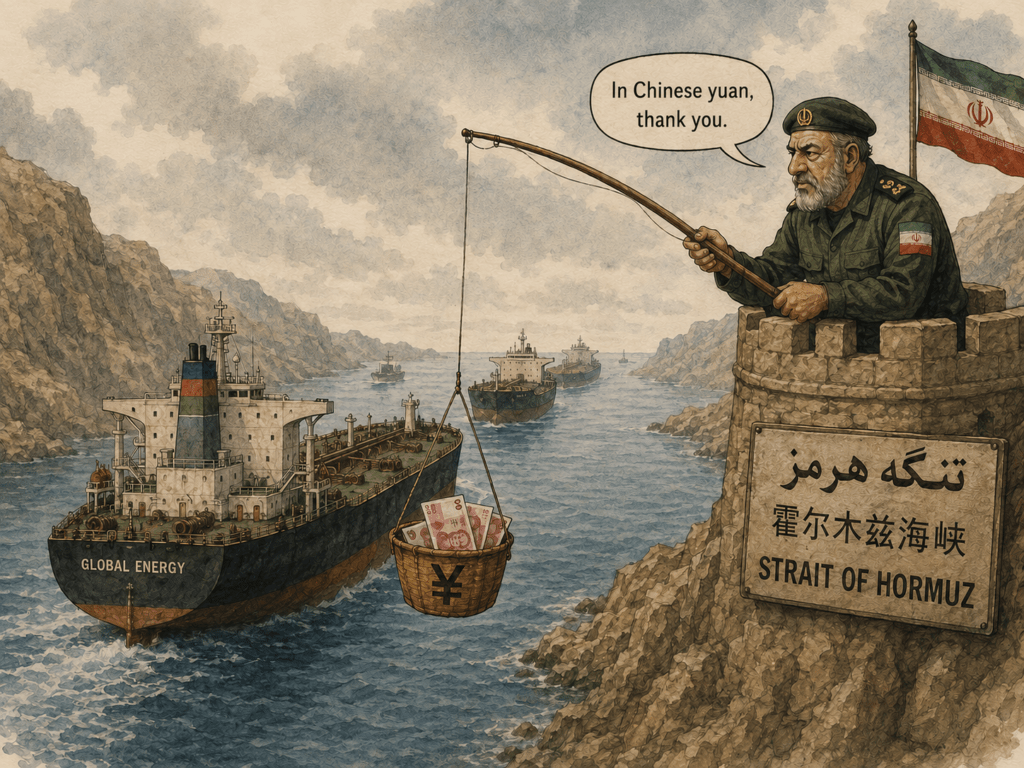
The war hasn’t done the Chinese currency any harm either: the value of the yuan against the dollar has risen significantly, and in international oil transactions, a growing number of countries are no longer using petrodollars, but petroyuans. Iran forces the ships that are allowed to pass through the Strait of Hormuz to pay a toll – not in dollars but in yuan. Another Chinese war profit: worldwide, interest in electric cars has surged. China has them in abundance; they are excellent and cheap.
Xi Jinping Comes Across as a Wise Leader
Set against the temporary losses, the Chinese leaders see permanent gains, and those carry much more weight. Xi Jinping’s prestige has risen sharply, especially in the Global South, and he didn’t even had to do much for it. Contrasted with the raving imperialist Donald Trump, Xi Jinping comes across as a wise leader who wants nothing to do with war. Opposite the American egotist and master demolisher stands the Chinese builder, who supposedly thinks only of development and progress. As international trust in the United States declines, China’s credit and soft power grow.
With his nonsensical Iran adventure, Trump has done a disservice not only to the world, but also to himself. During his last meeting with Xi Jinping in Beijing, he begged the Chinese leader to mediate with the Iranians. Xi was not at home. Perhaps it suits him juist fine if peace in Iran remains elusive for a while longer, just like in Ukraine. Because as a result, Trump will lose the last remnant of his prestige – and who will reap the rewards of that? Exactly.
Jan van der Putten is a writer and journalist, who previously served, among other things, as a correspondent in China. His latest book is: Tijd van illusies: Mijn kleine geschiedenis van de wereld” (Time of Illusions: My Little History of the World) published by Querido Facto